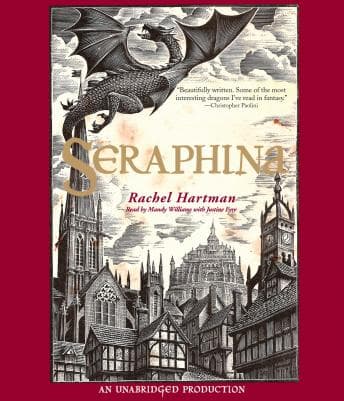

Twenty years of teaching has taught me one thing about dragons in literature: most authors get them wrong. They're either mindless beasts or wise mentors with scales. Rachel Hartman does something I haven't seen since Le Guin—she makes dragons boring. And I mean that as the highest compliment.
I was grading sophomore essays on symbolism in The Great Gatsby (they all think the green light means money, bless them) when Seraphina started playing. By the third paper, I'd stopped pretending to read. Hartman's dragons are scholars. Mathematicians. They find human emotion distasteful and inefficient. They can fold themselves into human form but consider it beneath them. This is what Hemingway said about iceberg theory—the restraint IS the power.
Mandy Williams voices Seraphina with this wonderful quality of someone who's spent her whole life keeping a secret that could kill her. There's a constant undercurrent of vigilance in her delivery. Justine Eyre handles the memory sequences—Seraphina's mother's voice, essentially—with a rueful maternal tone that works beautifully for the brief moments she appears. Here's the catch though: their voices are remarkably similar. I lost track twice in the first few hours of whose perspective I was in. Not a dealbreaker, but if you're driving I-90 at rush hour, you might want to rewind.
Prose That Rewards the Patient Reader
Hartman writes like someone who actually studied medieval court politics and music theory. The kingdom of Goredd feels researched, not invented. Seraphina herself is a court musician, and the in-book songs—Williams actually sings them, properly—add something I didn't know I wanted in my fantasy audiobooks. My students would hate this. The pacing is deliberate. The political intrigue unfolds across chapters, not paragraphs. There's a murder mystery at the center, but Hartman treats it like Umberto Eco would—as a lens for examining everything else.
The world-building requires your attention. This isn't background listening while you pretend to follow Principal Martinez's quarterly projections. Dragons have their own philosophy, their own logic of emotion suppression that mirrors certain stoic traditions. Seraphina's secret—which I won't spoil but which the book telegraphs early—becomes a vehicle for exploring what it means to belong to two worlds that despise each other. If you loved The Hero and the Crown, this is its spiritual successor, but more cerebral, more interested in ideas than action. That same intellectual approach to dragon lore shows up in Hidden Kingdom (Wings of Fire #3), though Hartman's dragons are far more restrained than Tui Sutherland's.
What the Audio Loses
I need to be honest here. Several listeners have noted that the audiobook lacks the glossary and character list that the print version includes. In a book with invented terminology and a sprawling cast of dragons-in-human-form, this matters. I found myself occasionally confused about which character was which, especially among the dragon scholars at court. The narration balances the multiple intrigues well, but there's a density to Hartman's prose that might reward having a reference handy.
At thirteen hours, this is a commitment. Some listeners run it at 1.4x comfortably, but I kept it at 1.0 because the language rewards slower consumption. Hartman's sentences have a musical quality that gets flattened at higher speeds.
Worth Pausing the Faculty Meeting For
Fantasy readers tired of dragons as plot devices—this is yours. Fans of Robin McKinley or Patricia McKillip who want their world-building layered and their heroines smart rather than chosen. Anyone who thinks young adult fantasy can't be literary. My AP Lit students who complain that classics are slow—this has the same deliberate pacing as Middlemarch, and it earns it.
Skip it if you want action-forward fantasy; this will frustrate you. If you need your audiobooks to work while multitasking, the similar narrator voices will trip you up. And if you're a purist about supplementary materials, maybe grab the print edition and listen to something else.
Hartman wrote something that trusts its audience to keep up, to care about court politics and philosophical debates about the nature of emotion. Williams and Eyre deliver it with warmth and intelligence, even if I wish their voices contrasted more sharply. Worth a credit, especially if you're the kind of listener who savors rather than consumes.