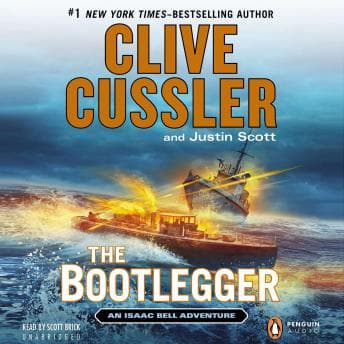

Look, I need to rant for a second. I picked up Bootlegger because I needed something lighter between my third reread of The Way of Kings and whatever LitRPG my Audible algorithm was pushing on me. Historical action-adventure, Prohibition era, rum runners, spies — sounds like a session zero for a great campaign, right? And it kind of is. But also kind of isn't. And that's the frustrating part.
I was deep into a late-night coding session — supposedly debugging my procedural generation framework, actually just staring at a terminal while my thesis wept quietly in a forgotten tab — when Isaac Bell's mentor Joseph Van Dorn gets gunned down during a high-speed boat chase. That opening sequence hits hard. Machine guns, speedboats cutting through the dark, the kind of kinetic chaos that makes you sit up and forget you were supposed to be working. Cussler and Scott know how to stage an action set piece the way a good DM knows how to run combat: fast, loud, and with just enough stakes to keep you gripping the table.
Isaac Bell Is Basically a Level 20 Rogue With Multiclass Into Noble
Here's my thing with Bell: he's competent to the point of absurdity. The guy is rich, handsome, impossibly skilled, connected to everyone who matters in 1920s America, and basically never loses. He's the character your powergaming friend brings to the table and your DM hates. That said — there's something satisfying about watching a protagonist just operate. Bell moves through Prohibition-era speakeasies, train tunnels, and dock warehouses like he's got the whole map revealed. When the Russian secret police execution method shows up — a witness eliminated with cold, professional precision — Bell doesn't panic. He pivots. He investigates. He's a detective who actually detects things, which is more than I can say for some fictional investigators.
The Prohibition setting is genuinely fun. Cussler clearly did his homework on the bootlegging operations, the political corruption, the way organized crime was reshaping American cities. It's not Sanderson-level world-building (nothing is, fight me), but there's enough period detail — the boats, the smuggling routes, the uneasy relationship between law enforcement and the new criminal class — that the 1920s feel lived-in rather than costumed. The period atmosphere actually reminded me of Black Panther: Panther's Rage in a weird way — both books lean hard on a specific cultural moment to do the heavy lifting that character depth probably should.
Scott Brick: The Narrator You Either Love or Endure
So Scott Brick. Here's the comparison that keeps bouncing around my head: if Steven Pacey walked so other narrators could run, Scott Brick drives a very reliable sedan at a consistent 65 mph. He's not doing anything flashy. He's not giving you the range of a Pacey performance where every character sounds like a different human being pulled from a different corner of the world. But Brick is solid. His Isaac Bell is authoritative and measured, which fits the character's unflappable nature. His pacing during the action sequences — the boat chases, the confrontations with Russian agents — carries real energy. You feel the momentum.
But I gotta be honest about the breathing thing. There are moments, particularly in the more intense scenes, where Brick does this breathy, almost ASMR-adjacent vocal thing that pulled me right out of the story. It's not constant, and it's not a dealbreaker, but once you notice it, you can't un-notice it. It's like hearing someone's dice hit the table too hard during a dramatic moment — technically fine, but it breaks the immersion.
Where the Plot Rolls a Nat 1
Here's where I can't sugarcoat it: the plot is pretty by-the-numbers. Bell gets a lead, follows it, fights someone, gets another lead, follows that. The Russian spy angle should add complexity — and conceptually it does — but the execution feels more like a series of encounters than a mystery with genuine twists. I kept waiting for the moment where everything clicks together, where the DM reveals the twist that recontextualizes everything you thought you knew. It... doesn't really come. The bad guys are bad. Bell is good. Things explode. Credits roll.
For a Cussler-Scott collaboration, this is par for the course. If you've listened to other Isaac Bell books with Brick narrating, you know exactly what you're getting. That's either comforting or disappointing depending on what you want.
Who's Rolling Initiative on This One
If you want a breezy, action-forward historical adventure that doesn't demand much from you — this is your audiobook. Perfect for road trips, long drives, or coding sessions where you need background stimulation but can't afford to lose focus on your actual work. (Not that I would know anything about that.) If you're looking for deep character work, intricate plotting, or a magic system that makes you want to diagram it on a whiteboard — this isn't for you. And that's okay.
At 11 hours, it's a clean, efficient listen. Not 40-hour Stormlight commitment. Not even close. But sometimes you don't want the full epic campaign. Sometimes you just want a solid one-shot.
My D&D Group Would Call This a Side Quest
I read this instead of writing my thesis, and I don't regret it — but I also won't be revisiting it. It's a well-executed action romp with a reliable narrator and a setting that deserves better plotting. Brick and Cussler are a proven combo, and if that combo already works for you, Bootlegger delivers exactly what's on the tin. Just don't expect it to surprise you.