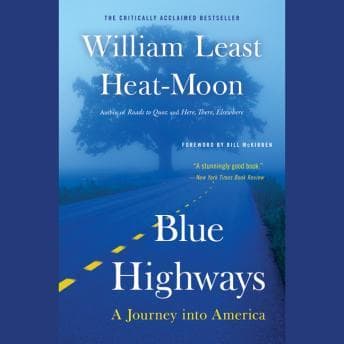

I was on a red-eye to Denver, couldn't sleep, and figured eighteen hours of backroads America might knock me out. Instead, I stayed awake until we landed, then kept listening in the Uber. That's either a sign of Heat-Moon's writing or evidence I need to address my relationship with sleep. Probably both.
Here's the thing about Blue Highways that nobody tells you upfront: the first hour is rough. Heat-Moon's marriage just ended, he lost his teaching job, and he's setting out in a Ford van named Ghost Dancing with the kind of existential weight that makes you want to shake him and say "get to the point, man." I almost bailed. Jenny would say I'm being harsh. Jenny is right. But here's why you shouldn't quit: somewhere around hour three, the book stops being about a man running from his problems and becomes about America actually talking to itself.
The Business Case for Slow Travel
I've consulted for companies that spend millions on "authentic consumer insights." Focus groups, ethnographic research, data mining. Heat-Moon did it better in 1978 with a van and a willingness to shut up and listen. The conversations he has in places like Dime Box, Texas and Nameless, Tennessee—these are the kind of unfiltered American voices that market researchers would kill for.
There's a section where he's talking to a Kentucky farmer about land ownership and generational wealth that hit me harder than any McKinsey deck on rural economics. My parents came to this country with nothing and built something in Koreatown through sheer stubbornness. Heat-Moon finds that same stubborn hope in every small-town diner and gas station. The difference is he has the luxury of observing it. My parents were too busy living it to write it down.
Joe Barrett's narration is clean, professional, no-frills. He's not doing accents or character voices—this isn't that kind of book. What he does well is pace. He knows when to let Heat-Moon's prose breathe and when to push through the more philosophical tangents. An Audie winner for good reason.
Eighteen Hours of Asking Better Questions
The book is essentially a clinic in asking good questions. Heat-Moon walks into places where he clearly doesn't belong—small-town bars, reservation diners, rural churches—and people talk to him. Not because he's charming, but because he's genuinely curious. That's a skill I've watched consultants try to teach for years. Most fail.
The cadence of the language is what keeps you hooked through eighteen hours. Heat-Moon writes in this rhythmic, almost meditative style that works surprisingly well at 1.0x speed. Bhagavad Gita: Treatise of Self-help has that same deliberate pacing—you can't rush wisdom, apparently. I tried bumping it to 1.5x and lost something essential. The pauses between thoughts matter here. This is not a book you can optimize. Trust me, I tried.
Some listeners compare this to Kerouac's On the Road, but that's lazy. Kerouac was running toward something. Heat-Moon is running away from something and accidentally finding meaning in the detours. Narrative of the Life of Frederick Douglass also finds unexpected meaning in a journey—though Douglass was running toward freedom, not away from a failed marriage. Blue Highways is a more mature book, less romantic, more honest about what you actually find when you go looking for America.
Don't Skip the Slow Opening
I almost told you to skip to chapter three. But I'd be wrong. The slow opening establishes the emotional stakes that make the later discoveries land. You need to feel Heat-Moon's desperation to appreciate his relief when a stranger in a nowhere town gives him exactly the conversation he needed.
This is one of the rare eighteen-hour audiobooks where the length feels earned. Every detour, every tangent about place names and local history, builds toward something. I'm not sure what that something is—maybe just a more complete picture of a country that's easier to love in small pieces than as a whole.
Who Should Listen (And Who Should Keep Driving)
If you need a business book with frameworks and action items, this ain't it. If you want something to listen to on a long drive that makes you want to take the next exit and see what's there—this is perfect. It's also surprisingly good for flights when you want to feel grounded while being 35,000 feet up.
Not for the impatient. Not for the productivity-obsessed. (I say this as someone who is both.) But sometimes you need a book that asks you to slow down. My 2.0x speed couldn't save this one—and for once, I didn't want it to.