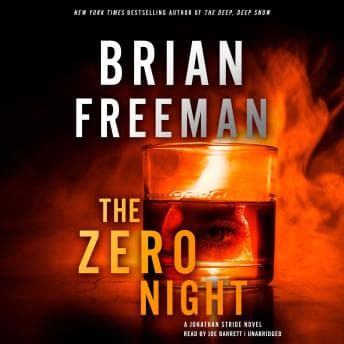

I was sorting through a box of donated books at the library - the usual mix of romance novels and outdated self-help - when I hit hour twelve of this audiobook. Someone had to physically tap my shoulder because I'd missed two patrons waiting at the desk. That's the kind of grip Brian Freeman's debut has. It's also the kind of book that made me grateful I wasn't listening in the dark, because the dread here isn't supernatural. It's human. And that's always worse.
The Cold That Gets Under Your Skin
Duluth, Minnesota in winter. Freeman doesn't just set his story there - he weaponizes it. The frozen landscape becomes this oppressive presence, and Joe Barrett's raspy delivery makes you feel every bitter gust off Lake Superior. When teenage girls start disappearing, the cold stops being atmospheric and starts feeling like a character. Like something waiting.
Here's what Freeman understands that so many thriller writers don't: horror isn't about the monster. It's about the anticipation. The first victim, Kerry McGrath, is sweet and ordinary. The second, Rachel Deese, is anything but - sexually charged, volatile, the kind of character who makes you uncomfortable in the best way. The contrast works because Freeman isn't interested in giving you a simple serial killer narrative. He's interested in making you question everything you think you know.
The mystery construction here is tight. The clues are sparse - some listeners have complained about this, but I'd argue that's the point. Lieutenant Jonathan Stride isn't solving a puzzle with neat edges. He's stumbling through a web of lies that stretches from the frozen north woods to the neon heat of Las Vegas. The tonal whiplash between those settings could've been jarring, but Barrett handles the transitions like he's been narrating thrillers his whole career.
Barrett's Raspy Magic (With Caveats)
Look, I need to be honest about something. Barrett is excellent - his voice has this dusky quality that's perfect for noir-adjacent material, and he moves through accents and character voices with real precision. The rapid-fire dialogue scenes? Nailed. The emotional gut-punches? He lands them.
But.
Some of his female character voices made me wince. Not all of them - he handles Stride's wife with surprising nuance - but there are moments where the higher register feels forced. And the sexually explicit scenes? (Yes, there are several. Content warning appreciated.) Having a single male narrator voice those sequences gets awkward. I won't say silly, but... okay, sometimes silly. It's not a dealbreaker, but it's something you should know going in.
The pacing also wobbles in the middle third. There's a stretch around hours seven through ten where Freeman is laying groundwork that pays off spectacularly later, but in the moment, I found my attention drifting. Barrett keeps things moving, but even his steady delivery couldn't fully mask the slower sections.
Why This Debut Won All Those Awards
Freeman won the Macavity for this. Was a finalist for the Edgar, the Dagger, the Anthony, and the Barry. That's not hype - that's the mystery community recognizing something special. And what they recognized, I think, is that Freeman writes psychological suspense the way Shirley Jackson wrote horror. (Yes, I'm making that comparison. That same slow-burn dread lives in Flicker in the Dark, though Willingham's protagonist is unraveling in a completely different way. My podcast listeners can fight me.)
The secrets Stride uncovers don't just solve the case. They change him. There's a moment near the end - I won't spoil it - where everything clicks into place and you realize the story you thought you were listening to isn't the story at all. That's craft. That's someone who understands that the best thrillers aren't about catching the bad guy. They're about what catching the bad guy costs.
At eighteen hours, this is a commitment. But it's the kind of commitment that rewards you. I finished at 2 AM, sitting in my apartment with Shirley (the cat, not the author) giving me judgmental looks because I'd forgotten to feed her. Worth it.
Who Should Press Play (And Who Should Walk Away)
If you're into police procedurals with actual psychological depth - not just "detective has a dark past" window dressing, but real character work - this is your book. Fans of Tana French will find familiar territory here, though Freeman's approach is grittier, more explicitly violent.
Skip if you need your mysteries tidy. Skip if single-narrator audiobooks with multiple character voices drive you crazy. And definitely skip if you're sensitive to sexual content, because Freeman doesn't fade to black.
But if you want a thriller that trusts you to keep up, that respects the genre while pushing against its conventions? This is the one. My podcast episode on this is going to be long. Shirley (the cat) is already annoyed.