
When's the last time you actually laughed reading - or listening to - anything about Jesus?
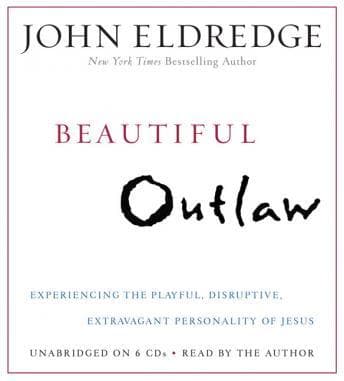
I was prepping for a Sunday call with a founder who's hemorrhaging cash (standard Tuesday energy, except it was Saturday night), and I had this queued up mostly because Jenny had been nudging me toward it for weeks. "You grew up in the church, David. You should listen to something that isn't about unit economics for once." Fair. So I put it on while making kimchi jjigae at 11 PM, and within twenty minutes I'd stopped stirring because Eldredge was describing Jesus at the wedding in Cana - not as some serene holy card figure, but as a guy who basically said "the party's dying, let me fix this" and turned water into wine that was better than the expensive stuff they'd already served. Eldredge frames it as divine mischief. And honestly? That landed.
The Jesus Your Sunday School Teacher Edited Out
Here's what Eldredge does well: he takes Gospel scenes you've heard a thousand times and strips the stained-glass filter. Jesus wasn't just healing people - he was picking fights with religious bureaucrats, cracking jokes his disciples probably half-understood, and making the establishment so uncomfortable they literally conspired to murder him. Eldredge spends the first half building out this personality profile - Jesus as fiercely playful, disruptive, generous to the point of scandal. The scene where he describes Jesus' interaction with the Pharisees isn't presented as theology. It's presented as a guy who walked into a room of self-important gatekeepers and basically said "you're done." My parents dealt with those people. Every Korean church has them. The portrait hit home in a way I wasn't expecting.
The comparison to Wild at Heart is inevitable, and it's earned. Eldredge has a formula: take something the church has made safe and boring, then argue passionately that the original version was dangerous and alive. With masculinity, it worked for a lot of men. Here, he's doing it with Jesus himself. The first half is genuinely strong - he builds a case that we've domesticated the most radical figure in human history into a greeting card.
Where the Deck Gets Padded
But - and you knew this was coming - the second half loses altitude. Eldredge shifts from "here's who Jesus really was" to "here's how you can experience this Jesus daily," and the practical application section feels thinner. Not bad, just... less electric. The energy drops from "I'm reading you into a paradigm shift" to "here are some spiritual exercises." At 7.5 hours, this book is roughly 4.5 hours of genuine insight and 3 hours of material that could've been a companion guide. Skip to chapter 5 if you're re-listening. Thank me later.
The devotional pivot will work for some people - Jenny genuinely loved that part - but for anyone coming at this from a more analytical angle, the back half feels like the author ran out of new observations and started coaching. Glennon Doyle runs into a version of the same problem in Carry On, Warrior - the raw, honest observations in the early chapters give way to something that starts to feel more like a workshop handout than a memoir.
Eldredge Reading Eldredge (And Why It Works)
Author-narrated books are a coin flip. Half the time the author has the vocal range of a tax form. Eldredge is the good kind of exception. His voice carries the warmth and conversational rhythm that the writing demands - you can hear when he's building to something he's personally excited about, and when he's delivering a line he knows is going to land. There were moments I actually laughed out loud. In my kitchen. At midnight. Making soup. That doesn't happen with most Christian audiobooks, which tend to sound like someone reading a compliance manual with reverence.
He's not a trained performer, so don't expect dramatic character voices or production tricks. It's one guy, talking to you, with genuine conviction. His voice brings out what he was thinking when he wrote it - and for this particular book, that's enough.
Who Gets the ROI
If you grew up in church and feel like the Jesus you were taught about is flat, two-dimensional, or just... boring - this is for you. If you're a seeker who's curious but allergic to churchiness, the first half will surprise you. If you're looking for deep theological scholarship, this isn't it. Eldredge is a counselor and storyteller, not an exegete. He's building an emotional case, not an academic one.
People who've already read Wild at Heart and liked the approach will feel right at home. People who found that book reductive will probably feel the same way here.
The Consulting Debrief
Bottom line: the first half of this book does something genuinely rare - it makes a 2,000-year-old figure feel present, funny, and dangerous. This is what my parents did instinctively - they never talked about a distant theological Jesus; they talked about someone who was in the room. Eldredge puts that on paper better than most. The second half dilutes the impact, and at 2.0x I still felt the padding. But that first half? The key takeaway is worth the listen. The other 3 hours? Not so much. Jenny would say I'm being harsh. Jenny is right. But she also agrees the first half is special.