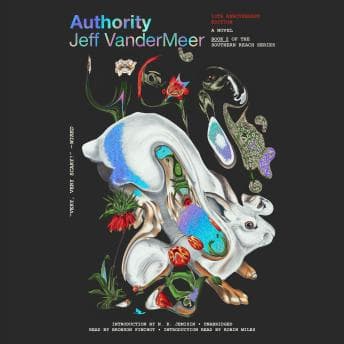

Look, I'm going to complain about something first. Jeff VanderMeer named his protagonist "Control" - a man who spends the entire book losing control of everything around him. And yes, I spent the first hour rolling my eyes at what felt like the literary equivalent of naming a character "Irony McIronyface." But here's the thing - by hour five, grading sophomore essays on The Great Gatsby at 11 PM, I'd completely forgotten to be annoyed because Bronson Pinchot had me so thoroughly unsettled that I was checking my own office door every few minutes.
This is why we still read the classics of weird fiction. Because VanderMeer isn't doing cheap horror. He's doing Kafka with a Southern accent.
The Narrator Understands That Pause Is Punctuation
Pinchot's performance here is something I need my students to hear when they ask why delivery matters. His voice for "the Voice" - the unseen authority figure who calls Control with cryptic instructions - carries this aristocratic edge that immediately establishes power dynamics without a single word of exposition. When he shifts to the biologist from the first book (now simply called "Ghost Bird"), there's this clinical detachment that makes every syllable feel like an autopsy.
But it's his pacing that elevates this from good to genuinely impressive. The interrogation scenes - and there are many - unfold with these pensive pauses that let the wrongness seep in. VanderMeer writes sentences that should feel bureaucratic. Government memos. Procedural observations. Pinchot finds the rot underneath all of it.
The final two hours are where everything explodes into what I can only describe as creepy action. (My students would hate that phrase. I love it.) After nine hours of slow-burn unease, Pinchot shifts into something urgent and fractured, and I actually stopped grading to just... listen. Which tells you something, because those essays weren't going to grade themselves.
What VanderMeer Is Really Saying About Institutions
Here's where I put on my English teacher hat - the one Denise says makes me insufferable at dinner parties. Authority isn't really about Area X. It's about what happens when the people tasked with understanding something incomprehensible start becoming incomprehensible themselves.
Control arrives at the Southern Reach expecting to impose order. What he finds is an agency that's been staring into the abyss so long it's forgotten what normal looks like. Hidden notes in desk drawers. Over two hundred hours of video footage that nobody wants to watch. Colleagues who may or may not be compromised. VanderMeer captures institutional decay with the precision of someone who's sat through too many faculty meetings. (Principal Martinez, if you're reading this, I'm not making a comparison. I'm definitely not.)
The hypnotism sections will lose some listeners. I'll be honest - there were moments where I wasn't sure if I was confused because VanderMeer intended confusion or because I was also trying to calculate participation grades. But that ambiguity feels intentional. Control can't trust his own perceptions. Neither can we.
Who Should Queue This Up (And Who Should Run)
If you loved Annihilation and want more of the same fever-dream expedition horror - pump the brakes. This is a different animal. Office politics. Surveillance paranoia. The slow realization that you might be the thing that's wrong.
This reminds me of what Hemingway said about the iceberg theory - most of the horror is underneath, implied, felt rather than shown. That same restraint - the sense that something terrible is happening just outside the frame - shows up in Two Truths and a Lie, though it trades cosmic dread for domestic paranoia. If you need explicit monsters and clear answers, you'll be frustrated. If you loved House of Leaves or Shirley Jackson's institutional dread, this is its spiritual successor.
Do not - and I cannot stress this enough - listen to this as background audio. I tried that once while walking the lakefront with Denise. Missed an entire plot thread because a jogger distracted me. This demands focus. Ten and a half hours of it.
Worth Pausing the Faculty Meeting For
Pinchot's performance carried me through a book that could have felt like homework. The atmospheric tension lingered for days after I finished - that creeping sense that the familiar might be slightly off, that the building you work in might be watching back.
Is the "Control" naming device too obvious? Probably. Does the narrative ambiguity occasionally tip into frustration? Yes. But VanderMeer is doing something genuinely strange here, and Pinchot translates that strangeness into something you feel in your chest.
My students would hate this. Too slow. Too weird. Not enough happens.
I'm already downloading Acceptance.