
What happens when the thing you're most afraid of isn't a monster, isn't a ghost, isn't even a person - but a place that simply refuses to be understood?
I've been sitting on this trilogy for years. My podcast listeners have been yelling at me about it since roughly episode 47, and I kept putting it off because - honestly? - the Natalie Portman film adaptation left me lukewarm, and I was worried VanderMeer's prose wouldn't survive the translation to audio. I was wrong. I was so, so wrong. I started this at 10 PM on a Tuesday, shelving returns at the library after hours (yes, alone, yes, the fluorescent lights were buzzing, yes, it was perfect). By the time the biologist descended into the tower - or the tunnel, because VanderMeer won't even let you be sure what you're looking at - I had stopped shelving entirely and was just standing in the 800s section with my mouth slightly open.
Twenty-six hours. That's a commitment. And this trilogy earns about twenty-three of them.
Three Narrators, Three Textures of Dread
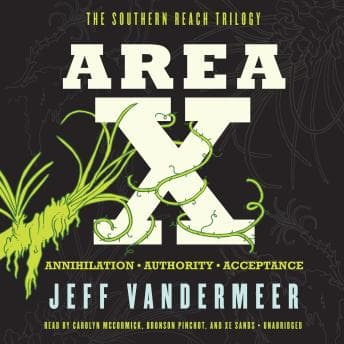
The decision to assign a different narrator to each book was either genius or a gamble, and it lands closer to genius. Bronson Pinchot handles Annihilation with this restrained, almost clinical detachment that mirrors the biologist's emotional armor - she doesn't name her colleagues, she catalogues instead of feeling, and Pinchot leans into that flatness in a way that makes every crack in her composure hit harder. When the biologist encounters the writing on the wall of the tower - "Where lies the strangling fruit" - Pinchot's voice drops into something reverent and wrong. The narrator commits. That's rare.
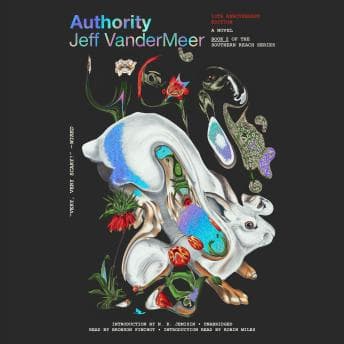
Carolyn McCormick takes over for Authority, and here's where opinions are going to split. Authority is a bureaucratic horror story. It's paranoia filtered through office politics, paperwork, and a protagonist called "Control" who is losing exactly that. McCormick plays it straighter, more procedural, which fits - but the pacing of this book is already the slowest of the three, and her measured delivery sometimes compounds that. I won't lie: I hit a stretch around hour twelve where my attention wandered. Not McCormick's fault entirely. VanderMeer wrote a middle book that trusts you to find the terror in institutional rot, and that's a harder sell in audio than on the page.
Xe Sands on Acceptance brings it home. Multiple timelines, multiple POVs, and Sands shifts between them with clarity that the material desperately needs. The lighthouse keeper sections - where we finally get the origin story of Area X's strangeness - are where Sands really locks in. There's a warmth to the keeper's voice that contrasts with the creeping wrongness of what's happening around him, and that gap between tone and content is where the real horror lives.
This Understands That Horror Isn't About Gore - It's About Dread
I've spent 200-plus episodes of my podcast arguing that the scariest thing a story can do is refuse to explain itself. Shirley Jackson understood this. VanderMeer understands this at a molecular level. Area X doesn't want to scare you. It doesn't care about you at all. And that indifference - that vast, biological, almost ecological indifference - is more unsettling than any jump scare or monster reveal.
The scene where the biologist realizes the tower is breathing. The moment Control finds a cell phone ringing in a drawer that shouldn't exist. The slow understanding that the border of Area X might not be holding something in - it might be expanding. This is horror that operates on the frequency of deep time, of ecosystems that don't need human permission to change.
Shirley Jackson walked so VanderMeer could run - sideways, into the shimmer, and never come back.
I listened in the dark. Mistake? Maybe. Worth it? Absolutely. Shirley (my cat) was unimpressed. I was terrified.
The Authority Problem (Let's Be Honest)
Book two is the weak link. I know it, you'll know it, and I suspect VanderMeer knows it too. The middle-book problem is real across long-form fiction — Feast For Crows taught me that a sprawling, necessary installment can feel like punishment even when the author is doing something genuinely ambitious with structure. Authority does essential worldbuilding work - the Southern Reach as an institution is fascinating, and the idea that bureaucracy itself becomes infected by the thing it's trying to contain is genuinely brilliant. But it's a slow burn inside a slow burn, and at audio pace, some of those repetitive office scenes feel like they're testing your commitment rather than rewarding it. If you bail during Authority, you'll miss one of the best final books in any trilogy I've consumed in years. Push through.
Who Needs This in Their Ears (And Who Doesn't)
If you scare easily, skip. If you don't, you need this. But more specifically: if you need answers wrapped in a bow, Area X will make you furious. VanderMeer gives you pieces. He gives you implications. He gives you an ending that feels like standing at the edge of something enormous and unknowable and choosing to step forward anyway. It's not resolution. It's acceptance. (The title of book three is doing a lot of work.)
If you loved The Left Hand of Darkness for the way it made alienness feel truly alien. If you've ever read Lovecraft and thought "this but without the racism and with actual emotional intelligence." If you think ecological horror is an underserved genre. This is yours.
My podcast listeners are going to love this. I'm already planning the episode.
The Spores Have Already Reached You
Finally, horror that respects the genre. Twenty-six hours of my life, and I came out the other side changed in ways I can't fully articulate - which, if you've read the books, you'll recognize as exactly the point. The three-narrator structure mostly works, the production is clean, and VanderMeer's prose translates to audio better than I expected. Authority drags. The other two books make you forget that Authority dragged. And that last hour of Acceptance - I was sitting in my car in the library parking lot in the dark, engine off, just listening.
I didn't want to go inside. The world felt different. That's what good horror does.