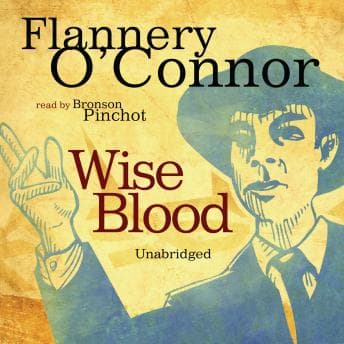

Look, I need to lodge a formal complaint with Flannery O'Connor's ghost. I was listening to this at a faculty meeting — one of those end-of-year budget things where Principal Martinez reads spreadsheets like they're Scripture — and Hazel Motes started preaching about his Church Without Christ from the hood of his rat-colored Essex, and I actually laughed out loud. Not a quiet chuckle. A bark. Martinez stopped mid-sentence. Twenty-three colleagues turned around. I pretended I was coughing. Denise says I deserve whatever happens next.
But here's the thing about Wise Blood — O'Connor's first novel, written when she was basically the age of my older students, which is terrifying — it shouldn't be funny. A man who desperately wants to not believe in God, who founds a church dedicated to nothing, who blinds himself with quicklime at the end. None of that reads as comedy on paper. But O'Connor writes with this ice-cold precision where every grotesque moment is also absurd, and Bronson Pinchot gets that. He gets it.
The Southern Gothic as Stand-Up Routine
Pinchot's drawl is the real thing here — not a cartoon Southernness but the kind of flat, hard vowels you hear in rural Georgia, where O'Connor set most of her work. When he voices Hazel Motes, there's this tight, almost strangled quality, like a man whose jaw is clenched against his own words. Hazel's preaching scenes — standing on that Essex, shouting at strangers who couldn't care less — Pinchot plays them with a desperate sincerity that makes the comedy land harder. He's not winking at you. Hazel isn't in on the joke. That's what makes it devastating.
Enoch Emery is where Pinchot really separates himself. Enoch's this lonely, feral kid who believes his blood tells him things, and Pinchot gives him a higher, more nasal register — eager, a little unhinged, like a stray dog that follows you home and you can't shake. The scene where Enoch steals the mummified shrunken figure from the museum — his "new jesus" for Hazel's church — Pinchot narrates it with this breathless, almost reverent energy that's both hilarious and deeply unsettling. You're laughing and then you realize, oh, this is actually about loneliness so profound it bends reality.
Now — fair warning. Some of the secondary voices do bleed together. Asa Hawks and a couple of the minor characters share enough vocal territory that you might lose track during dialogue-heavy stretches. At under five hours, the book moves fast enough that it didn't derail me, but if you're listening while distracted (say, pretending to care about fiscal year projections), you'll want to rewind a few passages.
What O'Connor Is Really Saying (And Why My Students Would Hate It)
This reminds me of what Hemingway said about prose being like an iceberg — the dignity of movement is due to only one-eighth being above water. O'Connor works the same way but meaner. Every sentence in Wise Blood is doing three things at once. Hazel's obsession with proving God doesn't exist is, of course, the most God-haunted behavior imaginable. The "blind" preacher Asa Hawks who isn't actually blind. The Church Without Christ that still needs a church. O'Connor stacks irony like bricks, and the whole structure is a cathedral whether Hazel wants it to be or not.
I teach Southern Gothic to juniors who'd rather be doing literally anything else, and I always struggle with O'Connor because her work requires you to sit with discomfort. She doesn't offer easy redemption arcs. Hazel's ending — the self-blinding, the barbed wire, the slow wasting — isn't triumphant. It's horrible and holy at the same time. The prose deserves to be savored, and at 1.0x speed, Pinchot gives those final chapters the weight they need. The narrator understands that pause is punctuation.
Who This Is For (And Who Should Run)
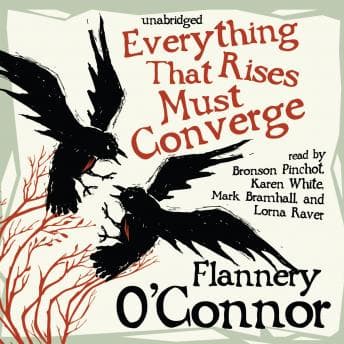
If you loved Cormac McCarthy's early Southern work — Outer Dark, Child of God — this is its spiritual ancestor. O'Connor got there first, with more humor and sharper theological teeth. If you're coming to O'Connor from her short stories ("A Good Man Is Hard to Find," "Everything That Rises Must Converge"), Wise Blood is rawer, less polished, but the DNA is all here.
Skip this if you need likeable characters or tidy endings. My students would hate this. I love it. Every character in this book is broken in ways that don't get fixed, and O'Connor insists you look at them anyway. I ran into something similar reading Lock and Key: The Gadwall Incident — not the same theological weight, not by a long shot, but that same refusal to sand down the uncomfortable edges of its characters.
Also skip if you're bothered by narrators who commit fully. Pinchot doesn't hold back — his Sabbath Lily Hawks has a wheedling, manipulative sweetness that made my skin crawl, which is exactly right. But some folks want a more neutral read, and that is emphatically not what's happening here.
Worth Pausing the Faculty Meeting For
Five hours. That's all it takes. Shorter than most committee meetings I've survived, and infinitely more valuable. Pinchot turns O'Connor's already ferocious prose into something that feels performed in the best sense — like a one-man show in a church basement where the lights keep flickering. This is why we still read the classics. Not because they're comfortable, but because a woman from Milledgeville, Georgia wrote about a man running from God in 1952 and it still sounds like it was written yesterday.