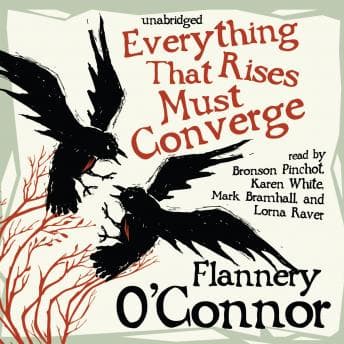

Flannery O'Connor is the meanest writer in the American canon, and I mean that as the highest possible compliment.
I finished this collection on a Sunday morning walk along the lakefront with Denise, and when the last story ended I just stopped on the path and stood there. She asked if I was okay. I wasn't sure. O'Connor does that - she leaves you standing still in the middle of your own life, suddenly aware of how thin the floor is beneath your feet.
Every Character Thinks They're the Hero
This is what I try to get my students to understand about O'Connor, and what this audiobook nails with startling clarity: every single person in these stories believes they are the reasonable one. Julian in the title story is convinced he's the enlightened liberal correcting his mother's backwards racism, but O'Connor peels him back layer by layer until you see he's just a petulant child using moral superiority as a weapon. When his mother collapses after being struck on the bus - that moment where Julian's smugness cracks into raw, childish terror - it's one of the most devastating reversals in American fiction. And the thing is, you can't even hate him for it. You recognize him. You've been him.
"Revelation" might be the best story in the collection, and Lorna Raver's reading of Mrs. Turpin is something I won't forget soon. Mrs. Turpin sits in that doctor's waiting room mentally ranking everyone by class and race, thanking Jesus she wasn't made trash, and Raver gives her this warm, self-satisfied tone that makes you almost like her before the whole thing detonates. The vision at the end - that procession of souls entering heaven with all Mrs. Turpin's virtues burned clean away - that's O'Connor at her most terrifying and most generous simultaneously.
And then there's "A View of the Woods," where Mark Bramhall voices Grandfather Fortune with this stubborn, possessive growl that made me physically uncomfortable. The old man's obsession with progress, his willingness to sell off the family land just to spite his son-in-law - Bramhall makes you hear the self-destruction in every syllable. That voice will stay with me. There's a specific quality he brings, this mix of frailty and meanness, that captures exactly how O'Connor writes old men who've confused control with love.
Four Narrators, One Ruthless Vision
The multi-narrator approach works here in a way it doesn't always work with short story collections. Each narrator gets assigned stories that suit their strengths, and the transitions between voices actually mirror the way O'Connor shifts register from story to story. Karen White reading "Greenleaf" as Mrs. May - self-righteous, long-suffering, absolutely certain the universe owes her better - is a masterclass in performed irony. You can hear Mrs. May's conviction that she's the only competent person in Georgia, and White never winks at the audience. She plays it straight, which is exactly right, because O'Connor's comedy depends on the characters not knowing they're funny.
Bronson Pinchot handles the title story and brings Julian's intellectual posturing to life without making him a caricature. There's a fine line between showing us Julian is a fraud and turning him into a cartoon villain, and Pinchot walks it perfectly. His Southern accent work is precise without being showy - you hear class distinctions in the vowels.
I listened at 1.0x, obviously. The prose deserves to be savored. O'Connor's sentences are loaded weapons, and if you speed past them you'll miss the moment the safety comes off. These stories are short - the whole collection is just over nine hours - but they're dense. I'd finish one and need to sit with it before starting the next.
Who This Is For (and Who Should Brace Themselves)
If you teach literature, this is essential listening. If you loved Wise Blood or A Good Man Is Hard to Find, this collection is its spiritual successor - same Georgia grotesque, same theological violence, but the craft is even more controlled. My students would hate this. I love it. The stories move slowly, the violence arrives like a car wreck you saw coming three pages ago but couldn't stop, and nobody gets a happy ending because O'Connor doesn't believe in that kind of mercy. She believes in the other kind - the kind that breaks you open whether you want it or not. The closest I've come to that same feeling of being broken open by fiction - that specific discomfort of a story that refuses to let you off the hook - was reading It Starts with Us, though O'Connor would have made that ending a great deal more violent.
Not ideal for background listening. Not even close. This demands your attention the way a good sermon does - and I mean a sermon that makes you squirm, not one that makes you feel good about yourself.
The Assignment I'd Give My Students (If They'd Actually Do It)
Listen to "Revelation" and then tell me who the hero is. If you say Mrs. Turpin, you weren't paying attention. If you say Mary Grace - the girl who throws the book - you're getting warmer. If you say nobody, you're almost there. And if you say everybody and nobody at the same time, welcome to Flannery O'Connor. Worth pausing the faculty meeting for. Worth pausing everything for.