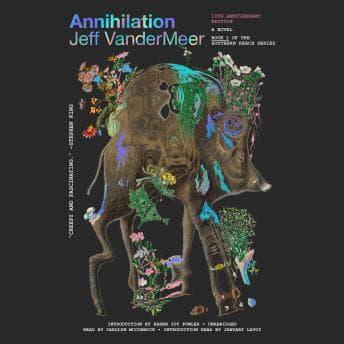

Look, I teach high school English. I've spent two decades watching teenagers zone out during Kafka discussions, so when I say VanderMeer writes like Kafka got lost in a nature documentary and decided to stay there, I mean it as the highest compliment.
I finished Annihilation while grading sophomore essays on The Great Gatsby at 11 PM. The juxtaposition was... something. Fitzgerald's green light versus VanderMeer's lighthouse. American dreams versus American nightmares. My students would hate this comparison. I love it.
The Biologist's Voice in My Head
Here's the thing about Carolyn McCormick's narration - it's divisive, and I get why. She reads with this clinical detachment that some listeners find flat. But that's the point. The biologist isn't supposed to be warm. She's a scientist cataloging her own dissolution, and McCormick understands that pause is punctuation.
The calm is the horror.
When she describes the tower (or tunnel, depending on your orientation) with that same measured tone she uses for everything else, the effect is genuinely unsettling. It's like listening to someone describe their own autopsy while it's happening. No hysteria. Just observation. "The words were written in a living script," she tells us, and McCormick delivers it like she's reading a field report. Which, of course, she is.
Now, I'll be honest - there were moments during my lakefront walks with Denise where I had to rewind because the steady pacing lulled me into my own thoughts. But that's less a criticism and more an acknowledgment that this isn't a thriller. It's a meditation disguised as an expedition.
When the Prose Starts to Drift
VanderMeer does something fascinating here that my AP Lit students would appreciate if they'd stop checking their phones. The prose itself becomes part of the contamination. Early chapters read like standard expedition journals - clinical, organized. But as Area X works on the biologist, the language starts to... drift. Memories interrupt. Time folds.
This is why we still read the classics, honestly. Because writers like VanderMeer are in conversation with them. I kept thinking about Heart of Darkness, about Solaris, about all those stories where the journey inward matters more than the destination. The Southern Reach isn't just a place. It's a psychological state.
The book clocks in at just over six hours, which feels right. Any longer and the atmospheric dread might tip into tedium. Any shorter and you'd miss the slow accumulation of wrongness that makes the final third so effective. VanderMeer knows exactly how much weird to deploy and when.
The Crawler Scene (and That Marriage)
Without spoiling anything - the crawler scene. You'll know it when you hear it. McCormick's unwavering calm during that sequence is genuinely chilling. My coffee went cold. I forgot I was supposed to be grading.
And the husband subplot. God. VanderMeer threads it through so carefully, these fragments of a marriage told in glimpses. The biologist isn't a reliable narrator - she knows it, we know it, and McCormick's delivery lets us hear the gaps in what she's willing to tell us. This isn't plot-driven fiction. It's character-driven horror wearing a sci-fi costume.
(Don't tell my students I called literary fiction "horror." They already think I'm ancient.)
Would I Listen Again?
Yes. But probably not immediately.
Annihilation is the kind of book that improves on reflection. I've been thinking about it for days - about what Area X represents, about the biologist's relationship to observation itself, about whether understanding something means destroying it. These are the questions that make literature matter.
That same atmospheric dread lives in Works of Edgar Allan Poe, Raven Edition, Volume 1, though Poe gets there through Gothic horror rather than ecological weird fiction.
If you loved Piranesi or The Road, this is its spiritual successor in terms of atmosphere. If you need action beats every chapter, you'll struggle. If calm narration puts you to sleep, maybe read the print version instead. But if you want six hours of genuinely literary science fiction that treats its weird premise with the seriousness it deserves? McCormick and VanderMeer have created something worth pausing the faculty meeting for.
(Principal Martinez, if you're reading this, I was definitely listening to your budget presentation last Tuesday. I wasn't. I was listening to this. Worth it.)