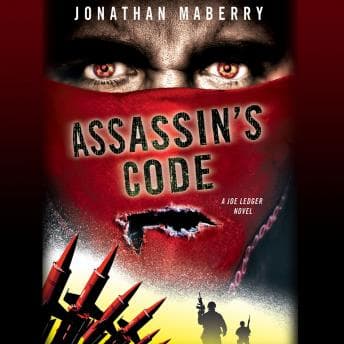

Look, I need to talk about the fact that Jonathan Maberry wrote a book where Joe Ledger — a spec ops soldier who punches things for a living — has to grapple with the existence of vampires. VAMPIRES. In a military thriller about nuclear bombs in the Middle East. And somehow, somehow, it mostly works? I found myself asking: why does this bother me less than it should?
I was chopping onions for a chana masala at 10 PM on a Tuesday (don't judge my timeline, the onions weren't going to caramelize themselves) when the story pivoted from geopolitical thriller to straight-up horror, and I actually set the knife down. Not because I was scared — because I was genuinely fascinated by how Maberry handles Joe's psychological fracture when his worldview cracks open.
When Your Protagonist's Defense Mechanisms Are the Real Villain
Here's what Maberry gets right that a lot of thriller writers miss: Joe Ledger doesn't just encounter the supernatural and go "well, guess that's a thing now." The man compartmentalizes. He intellectualizes. He deflects with dark humor that borders on dissociative. The protagonist exhibits classic trauma response patterns — he's already fractured into three internal personas before this book even starts, and when the Book of Shadows forces him to confront something that defies his rational framework, you can feel the coping mechanisms straining.
This is a fascinating case study in cognitive dissonance under extreme stress. Joe's trained to assess threats, categorize them, neutralize them. But when the threat category is "genetically-engineered killers with characteristics that look an awful lot like vampiric mythology," his entire threat-assessment framework breaks down. Maberry doesn't rush past this. He sits in it. And at fifteen and a half hours, he has the space to let that psychological unraveling breathe between the action sequences.
The character of Violin is interesting too — she's positioned as a love interest and ally, but what makes her work is that she represents a worldview Joe can't accept. She's already integrated the impossible into her reality. She's adapted. And Joe's resistance to her perspective tells you more about his psychology than any internal monologue could. The research actually shows that people cling harder to existing schemas when confronted with schema-violating information, and that's exactly what Joe does. My therapist would have thoughts about this character.
Ray Porter and the Joe Ledger Voice Problem
Ray Porter is genuinely excellent here. The man won an Audie for Project Hail Mary for a reason — he understands pacing, he understands when to push emotion and when to pull back, and his delivery of Maberry's dark humor lands every time. There's a dry, almost exhausted quality to how he voices Joe that fits perfectly. This guy has been through too much and he's tired and he's still going, and Porter captures that bone-deep weariness.
But — and this is a real but — Porter has a sameness problem with his male leads. Joe Ledger sounds like Joe Ledger, sure, but he also sounds pretty close to every other gruff, competent male protagonist Porter has voiced. The supporting cast gets more vocal variety than the main character sometimes. It's not a dealbreaker. It's more like... you notice it around hour eight, when you've been living inside this voice for a full workday and the tonal range starts feeling narrow. His female character work is better differentiated, actually. Violin gets her own register, which helps.
The action sequences are where Porter earns his paycheck. He modulates intensity without ever tipping into melodrama, and for a book with this many gunfights and supernatural confrontations, that restraint is critical. You don't want your narrator chewing scenery when the text is already doing plenty of that.
The Maberry Problem (And Why I Keep Coming Back)
Psychologically, some of this doesn't track. The Iranian government asking American special forces for help finding nukes in their own backyard requires a suspension of geopolitical disbelief that's almost harder than accepting the vampires. And Maberry's plotting can feel like he's throwing everything at the wall — nukes AND ancient conspiracies AND genetic engineering AND forbidden texts AND a romance subplot — and daring you to keep up.
But here's the thing. The man understands human nature, or at least he understands one very specific type of human nature: the person who keeps functioning under impossible pressure because stopping isn't an option. That's not just an action hero trope. That's a real psychological profile. And Maberry writes it with enough specificity that it feels observed rather than invented. I've seen that same observational precision in All That Remains, where the protagonist's coping mechanisms under pressure feel equally grounded in real human behavior.
Book four in a series is a weird entry point, and I wouldn't recommend starting here. There's accumulated character history that matters — Joe's internal fractures, his relationships, the DMS organizational dynamics. You'd lose layers.
Who Gets the Most Out of This
If you want pure military thriller, the supernatural elements will irritate you. If you want pure horror, the geopolitical stuff will bore you. But if you're the kind of person who watches both CNN and horror movies and thinks "what if both of these were happening simultaneously" — this is your book. Fans who've been with the Joe Ledger series will find exactly what they're looking for. Newcomers should start at book one.
Dedicated listening only. This is not a background-noise audiobook. You will miss plot threads, and Maberry will not wait for you to catch up.
The Case File Stays Open
I finished this at 1 AM with turmeric-stained fingers and a cold cup of chai, and I immediately wanted to argue with someone about whether Maberry's blend of horror and thriller is brilliant or reckless. Four books in, I still can't decide. But I keep listening, which tells me something about the psychology of the reader too. Sometimes the stories that unsettle your framework are the ones you can't put down.