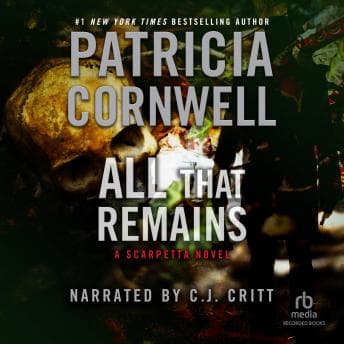

Everyone keeps telling me Patricia Cornwell is the queen of forensic thrillers. My podcast listeners have been requesting Scarpetta coverage for years. So here I am, finally diving into the series at book three - All That Remains - and honestly? I get it now. But I also have thoughts.
Look, this isn't horror in the traditional sense. No supernatural elements, no ghosts lurking in the Virginia woods where these couples keep disappearing. Though if you're craving actual ghosts, Giving Up The Ghost delivers on that front—different kind of terror, same tight pacing. But there's a different kind of dread here - the slow, methodical terror of knowing a killer is out there, leaving playing cards like breadcrumbs, and the people who should be catching him might be the ones protecting him. That's the kind of horror that keeps me up at night. The human kind.
The Jack of Hearts Problem
Cornwell does something I genuinely appreciate: she respects the procedural. The forensic details are meticulous without feeling like you're reading a textbook. Kay Scarpetta examines remains with the kind of clinical precision that would make Shirley Jackson proud - if Jackson had traded her haunted houses for autopsy tables. There's poetry in how Cornwell describes decomposition. (Yes, I just said that. No, I'm not apologizing.)
The central mystery - young couples vanishing, a serial killer taunting investigators with a jack of hearts - should feel dated at this point. The book came out in 1992. But the paranoia threading through it? The growing suspicion that the FBI might know more than they're letting on? That hits different now. Cornwell was writing about institutional rot before it was trendy.
What I didn't expect was how much this is a character study. Scarpetta isn't just solving crimes; she's navigating a minefield of professional jealousy, political pressure, and her own complicated relationships. The mystery is almost secondary to watching her try to do her job while everyone around her seems determined to make it impossible.
C.J. Critt's Scarpetta
Okay, so here's where I have to be honest. I couldn't find much about C.J. Critt online beyond this series, but based on this performance - she gets Scarpetta. The clinical detachment, the underlying vulnerability, the way Scarpetta's professionalism masks how personally she takes each case. Critt captures all of it.
The character work is solid. Each voice feels distinct enough that I never lost track of who was speaking, even during the longer investigation scenes. And there are a lot of those. Twelve and a half hours of them.
But - and this is where some listeners and I might diverge - the pacing occasionally drags. There are stretches where the narration feels a bit... flat? Not bad, exactly. Just not matching the intensity of what's happening on the page. When Scarpetta is piecing together evidence that suggests someone in law enforcement is complicit in these murders, I wanted the delivery to crackle with that revelation. Sometimes it did. Sometimes it felt like Critt was coasting.
I listened to most of this during late-night library cataloging shifts. (Yes, my job is exactly as atmospheric as it sounds.) The slower sections actually worked in that context - steady, methodical, matching the rhythm of sorting through old book donations. But I can see how commuters or workout listeners might find their attention wandering during the more procedural stretches.
The Ending That Wasn't
I need to address this because I've seen other listeners mention it: the ending doesn't deliver the punch you might expect. After all that buildup, all that paranoia about FBI involvement, the resolution feels... contained. Careful. Like Cornwell pulled back right when she should have gone for the throat.
This book understands that horror isn't about gore - it's about dread. And the dread is excellent here. It masters that same slow-build dread, though King actually commits to the payoff in ways Cornwell holds back from here. The problem is that dread needs release, and this book kind of... shrugs at the finish line.
Does that ruin it? No. The journey is worth it. Scarpetta is compelling enough that I'll absolutely continue the series. But if you're expecting a twist that recontextualizes everything - temper those expectations.
Who Should Listen (And Who Should Skip)
If you're into forensic procedurals and appreciate an author who actually knows what she's talking about (Cornwell's research is impeccable), this is your jam. If you want something that builds slowly, rewards patience, and features a female protagonist who's competent without the narrative constantly reminding you she's competent - yes. Do it.
Skip if you need constant action. Skip if detailed descriptions of decomposition make you queasy. (Fair.) Skip if you want your mysteries wrapped up with a satisfying bow - this one leaves threads dangling for future books.
My podcast listeners are going to love this, honestly. It's exactly the kind of grounded, reality-based horror that proves you don't need monsters to be terrifying. Sometimes the monster is just a guy with a deck of cards and friends in high places.
Shirley (my cat) was unimpressed. But she's unimpressed by everything that isn't tuna-flavored.