
"The President of the United States has vanished from the White House."
That's the opening hook. And honestly? I was folding laundry when Ray Porter delivered that line, and I just... stopped. Stood there holding a sock like an idiot. Because when you combine Jonathan Maberry's particular brand of military thriller chaos with Porter's delivery, you don't get to multitask. You just don't.
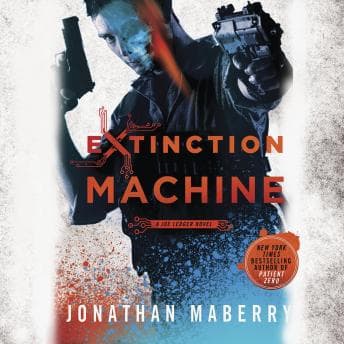
Look, I came to the Joe Ledger series late. Fifth book in, which is basically academic malpractice for someone who studies narrative psychology. But here's the thing about Extinction Machine - it doesn't care that you're late to the party. It grabs you by the collar and says "aliens, government conspiracies, and a protagonist with the emotional regulation of a caffeinated golden retriever. Keep up."
The Psychology of Joe Ledger (A Case Study in Controlled Chaos)
What makes Joe Ledger compelling - and I mean this as someone who has read approximately too many thriller protagonists - is that Maberry actually understands how trauma shapes action. Joe isn't just a tough guy with a gun. He's a tough guy with a gun who has genuine psychological complexity. The book references his internal struggles, his compartmentalized selves (the Warrior, the Cop, the Civilized Man), and while that could come across as gimmicky, it doesn't. It reads like someone who's actually thought about how people function under extreme stress. I saw similar psychological depth in Big Little Lies, where characters compartmentalize trauma in ways that feel uncomfortably real.
The research actually shows that individuals in high-stakes professions develop these kinds of mental frameworks. So when Joe's internal monologue shifts between tactical assessment and dark humor and genuine vulnerability, it tracks. Psychologically, this works. My therapist would have thoughts about this character, but they'd be interesting thoughts.
Ray Porter gets this. He doesn't play Joe as a monotone action hero or an over-the-top caricature. There's this... weariness underneath the snark. A heaviness that comes through even in the lighter moments. Porter's been with this series from the beginning, and you can tell. He knows Joe's rhythms like a close friend knows when you're pretending to be fine.
When Aliens Meet Military Thriller (And Somehow It Works)
Okay, so. UFOs. Alien technology. Dinosaur digs in China revealing extraterrestrial artifacts. On paper, this sounds like it could go very wrong very fast. Like, "I'm embarrassed to be listening to this on the train" wrong.
But Maberry does something clever. He grounds the absolutely bonkers premise in procedural detail. The DMS (Department of Military Sciences) operates like a real agency. The technology discussions feel researched. And the conspiracy elements - while wild - follow internal logic. This is a fascinating case study in how you can push genre boundaries without losing your audience, as long as you respect the rules you've established. Pieces of Her does something similar with its twisty premise - starts with one genre and pivots hard, but maintains internal logic throughout.
The pacing is relentless. Short chapters, constant cliffhangers, multiple POVs. Some listeners find this disruptive, and I get that. It's not a slow burn. It's a fast burn that occasionally throws gasoline on itself. But for a nearly 15-hour audiobook? I needed that energy. Why does this particular structure work for audio when it might annoy me in print? I think it's because Porter uses those chapter breaks as mini-resets. Each shift in perspective gets a slightly different vocal energy. It keeps you alert.
The Voice That Carries the Chaos
I couldn't find much about Ray Porter's specific preparation for this series online, but based on this performance, the man has clearly internalized an entire cast of characters. The villain voices don't sound cartoonish. The female characters aren't performed with that cringe-inducing "higher pitch = woman" approach that plagues so many male narrators. He differentiates through cadence, through attitude, through the small choices that make a voice feel like a person rather than a performance.
One listener called him "one of the best audiobook narrators out there," and... yeah. That's not exactly a hot take at this point, but it's earned. The action sequences in particular - and there are many - never become audio mush. You can follow who's doing what to whom, which is harder than it sounds when you're describing firefights and alien technology and government black sites all in the same chapter.
Who's This For (And Who Should Run)
Best for: Thriller fans who don't mind their military fiction with a side of X-Files. Commuters who need something that'll make the traffic disappear. Anyone already invested in the Joe Ledger series - this is apparently a fan favorite for good reason.
Skip if: You need your science fiction hard and your conspiracies realistic. If graphic violence bothers you (and there's plenty). If you're the type who gets annoyed by protagonists who are competent at everything. Joe Ledger is very good at being Joe Ledger, and if that irritates you, this won't convert you.
Content heads up: Violence (significant), language (also significant), and themes involving alien technology that occasionally veer into body horror territory. Not for the squeamish.
Case Closed (For Now)
Honestly? Probably wouldn't relisten immediately - it's dense, and I need to process. But would I continue the series? Already downloaded the next one. Porter's narration has essentially made this my preferred format for Maberry's work. Reading it in print would feel like watching a movie on mute.
The protagonist exhibits classic compartmentalization patterns that actually make psychological sense. The narrator understands the assignment. And the premise - while absolutely unhinged - is executed with enough craft that I stopped questioning it around hour three and just... went with it.
That sock never did get folded, by the way. C'est la vie.