
I don't usually do history. Give me a messy breakup or an enemies-to-lovers arc any day. But I needed massive background noise for a tedious pixel-perfect logo project—something long enough to drown out my upstairs neighbor—and this 19-hour beast seemed like it would do the trick.
Spoiler: It was... an experience.
The LibriVox Roulette
Here's the deal with volunteer audiobooks—it's a potluck. And not the curated kind where everyone brings artisanal cheese. I had the same wildly inconsistent experience with Little Men—also LibriVox, also a gamble. It's the kind where one person brings amazing homemade tamales and the next person brings store-bought potato salad that's been sitting in the sun.
Since this is a community project, the narrators change. A lot. Sometimes mid-flow. You get settled into a voice that's actually pretty decent—clear, rhythmic, maybe a little monotone but fine—and then BAM. New chapter. New voice. Suddenly it sounds like someone recording inside a tin can during a windstorm. Or the volume drops by half.
For someone like me who treats audio quality like a religion (Julia Whelan is my patron saint), this was rough. I spent way too much time fiddling with the volume knob instead of focusing on my typography. It pulls you right out of the immersion. You're not in Teheran anymore; you're listening to Dave from Ohio reading into his laptop mic.
A Victorian Road Trip (With Baggage)
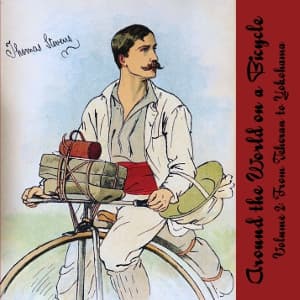
Thomas Stevens? The guy had guts. Or "pluck," as one of the other reviews put it. Riding a Penny Farthing—those terrifying high-wheel bikes—across Asia in the 1880s is objectively insane. My calves hurt just thinking about it.
But let's be real—the writing is dry. It's straight-up diary entries. There's no emotional arc, no character development, just... "I went here, the road was bad, the locals looked at me funny."
(And yeah, because it's from the 19th century, there are some... let's call them "dated" attitudes that made me cringe while feeding Diego his breakfast. It's very much a white guy in the 1880s looking at the world. You've been warned.)
Compared to modern travel memoirs like Wild or even Eat, Pray, Love, this feels stiff. It's an artifact, not a story. You don't feel the wind in your hair; you feel the dust in the library archives. The Art of War gave me that same archival feeling—historically important, sure, but emotionally distant.
Who's This Actually For?
If you're a hardcore cycling historian or genuinely curious what Persia looked like in 1885, have at it. Everyone else? Skip it. The inconsistent audio quality and emotionally flat prose make this a tough listen unless you've got a very specific itch to scratch.
Back to My Romance Novels
Look, it's free. I can't hate on a free passion project too much. I finished it—mostly out of stubbornness and because my hands were busy with vectors—but I didn't feel it. And if I'm not feeling it, what's the point? My heart needs the exercise more than my legs do.





![Steve Jobs [unabridged audiobook] audiobook cover](/_next/image?url=https%3A%2F%2Fcovers.audiobooks.com%2Fimages%2Fcovers%2Ffull%2F9788499923406.jpg&w=1920&q=75)