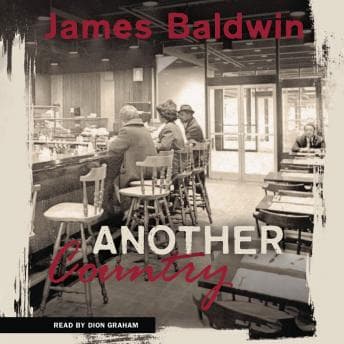

I've taught Baldwin for two decades. Assigned Go Tell It on the Mountain more times than I can count. Discussed The Fire Next Time until my voice gave out. But I'd never actually finished Another Country. Started it three times in grad school, always abandoned it somewhere around page 150. Too raw. Too much. Too honest about things I wasn't ready to examine.
So when I finally pressed play on this audiobook—grading a stack of mediocre essays on The Great Gatsby at 11 PM, Denise already asleep—I expected difficulty. What I didn't expect was Dion Graham's voice to make me forget I was holding a red pen.
Baldwin Doesn't Let You Look Away
This is not a comfortable book. Let's be clear about that upfront. Rufus Scott's suicide happens early, and then Baldwin spends the next fifteen hours forcing you to sit with everyone who failed him. Vivaldo, who loved him but couldn't save him. Ida, his sister, burning with a grief that becomes weaponized rage. Eric, whose absence during Rufus's spiral becomes its own kind of presence when he returns from France.
What Baldwin does—and this is why we still read the classics, why I force teenagers to wrestle with difficult texts—is strip away every comfortable lie we tell ourselves about race, about sexuality, about love. The sexual encounters are explicit, yes. Gay, bisexual, interracial. In 1962, this was incendiary. In 2024, it still has the power to make you shift in your seat. Not because of the acts themselves, but because Baldwin refuses to let sex be just sex. Every encounter is about power, about vulnerability, about the desperate human need to be truly seen.
My students would hate this. I love it.
Graham's Velvet Restraint
Here's where the audiobook becomes something special. Dion Graham—and I don't say this lightly—understands that pause is punctuation. His performance is what AudioFile calls "velvet intonation," and that's accurate, but it undersells what he's actually doing. Graham reads Baldwin the way Baldwin deserves to be read: at 1.0x, with room to breathe, with a low-key delivery that never competes with the prose.
Because Baldwin's sentences are already doing the work. They're already volcanic. Graham's genius is in not adding heat where heat already exists. When Ida unleashes her fury at Vivaldo—and there's a scene in the final third that left me staring at my ceiling at 1 AM, essays forgotten—Graham doesn't perform rage. He lets Baldwin's words rage. The restraint is the performance.
I've listened to narrators who would've chewed through this material, who would've made every emotional beat a capital-M Moment. Graham trusts the text. He trusts the listener. That's rare.
The Uncomfortable Mirror
Hemingway said the dignity of movement of an iceberg is due to only one-eighth of it being above water. Baldwin shows you the one-eighth. The affairs, the fights, the jazz clubs, the cold-water flats. But underneath is everything America in the 1950s refused to say aloud about itself. Everything we still, if I'm being honest, struggle to say.
The Greenwich Village scenes feel almost documentary. The Harlem sequences ache with a specificity that comes from lived experience. And France—when Eric is in France, there's this quality of exile that Baldwin knew firsthand. You can hear it. Graham makes you hear it.
Sixteen hours is a commitment. This isn't background listening. You can't fold laundry to this. You can't half-attend a faculty meeting while Rufus spirals toward the George Washington Bridge. (Principal Martinez, I was definitely paying attention to your budget presentation. I wasn't. I was listening to Baldwin describe the way jazz sounds when you're losing your mind.)
Class Dismissed
If you loved Giovanni's Room, this is its spiritual successor—bigger, messier, more ambitious. That same unflinching examination of desire and identity shows up in Edge, though it takes a completely different narrative approach. If you've only read Baldwin's essays, prepare yourself. The fiction cuts differently.
Who should listen: Anyone ready to sit with discomfort. Anyone who wants to understand why Baldwin matters. Anyone who believes great narration is performance art and wants proof.
Who should skip: If you need plot momentum, if you want resolution, if you're looking for something to make the commute go faster—this isn't it. Another Country demands your attention. It earns it, but it demands it.
The prose deserves to be savored. Graham savors it. So should you.