
"Love all, trust a few, do wrong to none."
I was grading a particularly dismal stack of Hamlet essays - the kind where students confuse Claudius with Polonius and think "To be or not to be" is about career choices - when Helena's voice cut through my exhaustion. Prunella Scales, delivering that line with such quiet conviction that I actually put down my red pen. That never happens.
Here's the thing about All's Well That Ends Well: my students would hate this. I love it.
The Problem Play That Earns Its Reputation
Scholar types call this a "problem play" because it refuses to behave like a proper comedy. Helena gets her man, sure, but Bertram is... well, Bertram is kind of terrible? He rejects his wife, runs off to war, tries to seduce another woman, and only accepts Helena after she essentially tricks him into consummating their marriage. The ending is "happy" in the same way that finishing a marathon with a sprained ankle is "successful." You got there. Congratulations?
But that's precisely why this play deserves more attention than it gets. Shakespeare is doing something genuinely uncomfortable here - asking us to root for a woman whose love object doesn't deserve her, then forcing us to watch her pursue him anyway. The classics don't let us off easy. Blue Cross does something similar with its moral ambiguity—no easy answers, just the uncomfortable truth.
The Marlowe Society's Gift to Your Ears
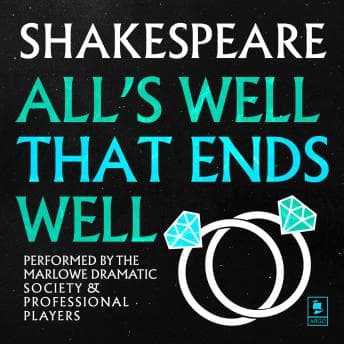
This ARGO Classics recording dates from an era when the Marlowe Dramatic Society was producing some of the finest verse-speaking actors in the English language. Michael Hordern brings a weary dignity to the King of France that makes his miraculous healing feel genuinely earned. And Roy Dotrice - who would later become one of the most prolific audiobook narrators of his generation - delivers Parolles with exactly the right balance of bluster and cowardice.
The full-cast format here isn't the slick, sound-designed production you might expect from modern audiodramas. This is theatrical performance captured on vinyl, now expertly remastered. You can almost feel the stage beneath them. The pacing respects Shakespeare's verse - the narrator understands that pause is punctuation - without becoming ponderous. At two and a half hours, it moves.
Prunella Scales deserves particular mention. Her Helena walks the impossible line between sympathetic and obsessive, and she does it through vocal choices alone. There's a slight tremor when Helena speaks of Bertram that suggests both genuine love and something more desperate. It's interpretation, not just recitation.
Dark Comedy's Spiritual Successor
If you loved Measure for Measure, this is its kin - another dark comedy where the "happy" ending feels more like exhausted compromise than triumph. Shakespeare seems to be asking: what does it mean when we get what we want, and it tastes like ashes?
Thurston Dart's musical direction adds period-appropriate flourishes that ground you in the Renaissance without overwhelming the text. Subtle work, the kind of attention to detail that's largely vanished from modern productions.
Worth Pausing the Faculty Meeting For
Let me be honest about the limitations. The research turned up almost nothing in terms of listener complaints or memorable moments - this is a lesser-known play in a historic recording series, so it hasn't accumulated the review volume of, say, a new thriller. I can't point you to specific timestamps where the production stumbles because, frankly, I didn't find any obvious flaws. The remastering is clean. The performances are uniformly strong. The text is the text.
What I can tell you is this: if you're the kind of listener who approaches Shakespeare with reverence - who wants to hear the words as they were meant to be spoken, by actors trained in the classical tradition - this recording delivers. If you want sound effects, modern accents, or a narrator who'll punch up the comedy for contemporary audiences, look elsewhere.
This reminds me of what Hemingway said about prose being architecture. The Marlowe Society builds Shakespeare's structure with care, brick by careful brick. They don't try to renovate.
Who This Is For (And Who Should Run)
Shakespeare completists, this is yours. Teachers who want students to hear what trained verse-speaking sounds like. Anyone who's worked through the major plays and wants to explore the weird corners of the canon. Listeners who appreciate that some performances are historical documents as much as entertainment.
Skip it if you need action, if you want your Shakespeare modernized, or if you're looking for an easy entry point to the Bard. This is graduate-level listening, and I mean that as a compliment.
Class Dismissed
Denise fell asleep during my explanation of why the bed-trick is thematically significant. But she agreed that Scales' performance was worth the two and a half hours. High praise from someone who usually prefers her audiobooks with more explosions.