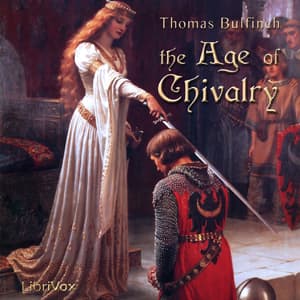

Denise and I were walking the lakefront last Saturday morning - one of those early fall Chicago days where the light off the water makes you feel like you're inside a Constable painting - and I was about three hours into Bulfinch's Age of Chivalry when she pulled out an earbud and said, "You look confused." She wasn't wrong. I was confused. And I stayed that way, on and off, for all ten and a half hours.
Here's the thing about Thomas Bulfinch: he wasn't trying to tell you a story. He was trying to give you an education. And in 1858, that meant something very different than it does now. This is a man who looked at the Arthurian legends - all that blood and betrayal and impossible love - and thought, "Let me sand down the edges so a proper American gentleman can reference Lancelot at a dinner party without blushing." The result is a book that reads more like a Victorian encyclopedia of chivalric motifs than a narrative. And as an audiobook? That creates some real problems.
The Museum Exhibit Where You Can't Touch Anything
Bulfinch's approach is essentially curatorial. He takes Malory, he takes the Mabinogion, he takes the French romances, and he presents them in these tidy summaries that strip away most of the psychological mess that makes the legends actually live and breathe. Merlin isn't the dangerous, ambiguous figure you get in, say, Mary Stewart's The Crystal Cave - he's a plot device wearing a robe. Guinevere's betrayal of Arthur, which should gut you, gets handled with the emotional weight of a footnote. The stories bleed into each other without much connective tissue, so by the time you're hearing about the fourteenth knight's fourteenth quest, you're not sure if you missed a chapter break or if Bulfinch just decided transitions were optional.
This reminds me of what Hemingway said about prose being architecture - well, Bulfinch built a building with beautiful individual bricks but forgot to put in hallways. You wander from room to room wondering how you got there.
Compare this to Howard Pyle's The Story of King Arthur and His Knights, which takes the same raw material and turns it into something a reader can actually inhabit. Pyle understood that myth needs emotional texture to survive the retelling. Bulfinch understood that myth needed to be catalogued. Both are valid impulses. Only one makes for a good audiobook. I kept thinking about Still Life, which also handles dense, layered material but trusts its narrator to do the emotional heavy lifting that the prose alone can't carry.
"Various Readers" Is Doing Some Heavy Lifting
The narration credit here is "Various Readers," which - let's be honest - is the audiobook equivalent of a potluck dinner. You're going to get some excellent contributions and some questionable casseroles. The quality shifts from section to section in ways that are noticeable but not catastrophic. Nobody embarrasses themselves, but nobody transforms the material either. There's no single voice anchoring you through ten-plus hours, which means every time a new reader picks up, your brain has to recalibrate. With material this dense and this prone to running together, that's a real obstacle.
I kept thinking about how a narrator like Derek Jacobi or even a strong single voice could have imposed the structure that Bulfinch's prose lacks. The narrator understands that pause is punctuation - but when you have multiple narrators with different instincts about pacing and emphasis, you lose that consistency. Some readers rush through the tournament scenes like they're reading a grocery list. Others find a nice rhythm in the more lyrical passages. It's uneven. Not bad, but uneven.
Who This Is Actually For (And Who Should Run)
If you're a student of mine asking whether this is a good entry point into Arthurian legend - no. Hard no. Start with Roger Lancelyn Green's King Arthur and His Knights of the Round Table or T.H. White's The Once and Future King. Come back to Bulfinch after you already love these characters, when you want to understand how a 19th-century American intellectual processed medieval romance through a Victorian moral filter. Because THAT is genuinely interesting, as cultural history.
If you're an English teacher, a medievalist, or someone who's already read Malory and wants to see how Bulfinch flattened and domesticated the material - this is worth your time. My students would hate this. I found it instructive in a way that was sometimes fascinating and sometimes deeply tedious. The prose deserves to be savored in places - Bulfinch could write when he wanted to - but ten and a half hours is a lot of savoring.
The Assignment I'd Give Myself
I don't regret the time. I do think this audiobook version makes Bulfinch's weaknesses louder and his strengths quieter. The inconsistent narration, the lack of dramatic interpretation, the sheer density of summarized plot - it all hits harder when you can't flip back a page to reorient yourself. This is a book I'd recommend reading in print with a pencil in hand, marking passages, cross-referencing. As an audiobook, it's homework. Sometimes good homework. But homework.
Worth streaming through Libby on a long walk if you're already a fan. Not worth a credit if you're hoping for the magic of Camelot. The magic got edited out somewhere around 1858.