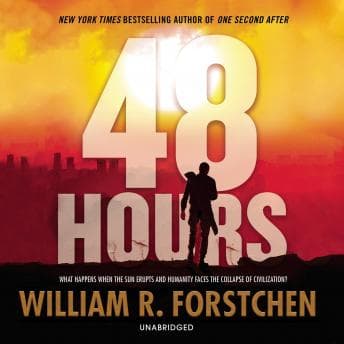

What would you actually do with 48 hours' warning before everything electronic on the planet gets fried?
I was up way too late on a Tuesday night — like, thesis-deadline-I'm-ignoring late — playing Gloomhaven solo (don't judge me, the AI companion app is genuinely good) when I decided to throw this on. Figured a disaster thriller would pair well with dungeon crawling. And honestly? It kind of did, in the sense that both involve watching society collapse one bad decision at a time.
The Carrington Event Gets the Sanderson Treatment (Almost)
So here's the pitch: a coronal mass ejection is about to slam into Earth, and humanity has exactly two days to prepare. Forstchen — who wrote the One Second After series, which is basically the gold standard for "what if the grid dies" fiction — takes a real scientific phenomenon (the 1859 Carrington Event) and asks what happens if it goes down in modern times. The magic system here is chef's kiss — except the magic system is astrophysics, and instead of Allomancy we get electromagnetic pulse theory and discussions about Faraday cages.
The info-dumps are real. If you don't like info-dumps, this isn't for you (but you're wrong). Forstchen has a PhD in Military History and History of Technology, and the man is not going to let you forget it. There are stretches where characters essentially lecture each other about solar weather, grid infrastructure, and the physics of coronal mass ejections. One listener review I saw said "a few times some information was over explained" and yeah — there are moments where a character will explain something, and then another character will re-explain it in slightly different terms, like Forstchen wanted to make absolutely sure you understood the science. But here's the thing: I eat that stuff up. My D&D group would love this as campaign research for a post-apocalyptic one-shot. The technical grounding is what separates this from generic disaster porn. That same appetite for world-building mechanics over hand-waving is something I appreciated in Around the World in 80 Days — Verne's obsession with how the technology of his era actually worked gives it a similar nerdy credibility that holds up even now.
The moral dilemmas are where this gets interesting. The decision to preemptively shut everything down — hospitals, communications, the internet — before the CME hits. That's not a clean call. People on life support. Planes in the air. The ethical calculus of "we have to break everything to save everything" is genuinely fascinating territory, and Forstchen doesn't shy away from the ugly parts.
Bronson Pinchot: Baldy from Perfect Strangers Reads the Apocalypse
Okay, so. Bronson Pinchot. The man has won basically every narration award that exists — Audible Narrator of the Year, Audie Awards, the works. He's articulate, his pacing is solid, and for most of this 11-hour listen, he's easy to ride with.
But.
There's a thing he does — and I've seen other listeners flag this — where certain dramatic moments get this capital-A Acting energy. Like he's performing Shakespeare at a regional theater when the scene just needs someone reading the news. It's not constant, and honestly for most of the book his delivery fits the material well. The more clinical, explanatory passages benefit from his precise diction. But when emotions ramp up, he occasionally overshoots the runway. Steven Pacey walked so other narrators could run, and Pinchot is sprinting in a direction I'm not always sure about.
I will say: at 11 hours 13 minutes, the length is right for what this is. It's not a 40-hour epic where you're living in the world — it's a tight countdown thriller. The real-time pressure of "48 hours" actually works at this runtime. You feel the clock.
Where the Grid Flickers
My biggest gripe: the characters are functional rather than memorable. They exist to move through the crisis and voice different perspectives on the disaster. Nobody here is Logen Ninefingers — nobody's going to live rent-free in your head after the credits roll. The progression is satisfying in terms of the disaster unfolding, but not in terms of character arcs. Forstchen is clearly more interested in the scenario than the people inside it, and if you're coming from character-driven fantasy like I usually am, that's an adjustment.
Also — and this is minor — the patriotic overtones get a little thick in places. "A tale of the resilience of American citizens" is literally in the publisher's description, and the book delivers exactly that tone. If you're looking for a more global or morally gray take on civilizational collapse, this plays it pretty straight.
Roll for Initiative Against the Sun
Look, if you burned through Forstchen's John Matherson novels and want more grid-down scenarios, this is your next listen. If you're the kind of person who has a go-bag packed and strong opinions about solar panels, you probably already own this. For the fantasy nerds like me who wandered in from a different aisle — it's a solid, science-heavy disaster thriller that respects your intelligence even when it over-explains. Not life-changing, not a waste of a credit. Somewhere in the middle, leaning positive.
I read this instead of writing my thesis. Dr. Patel would probably argue that a book about electromagnetic catastrophe is at least adjacent to computer science. I wouldn't push it.