
I was supposed to be debugging a pathfinding algorithm for my thesis today. Specifically, a heuristic for procedural terrain generation that keeps crashing my laptop. But somewhere around line 400 of the code, I realized I needed to listen to someone who actually knows how to get from Point A to Point B without a segmentation fault.
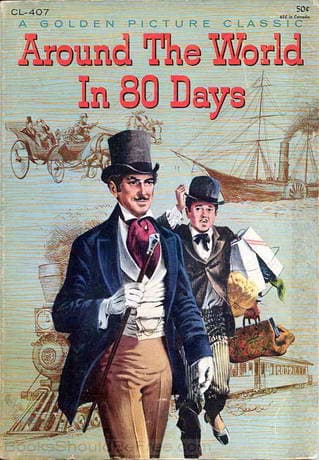
Enter Phileas Fogg.
I grabbed this audiobook because it's short—just over 7 hours—which is basically a novella compared to the 40-hour behemoths I usually devour. (Looking at you, Rhythm of War.) I figured I could knock this out in one long coding session. And honestly? It was the perfect palate cleanser.
The OG Speedrun
Let's be real for a second. Phileas Fogg is not a human being. The man is a walking, talking state machine. He's an algorithm in a top hat. As a guy who spends his life trying to make code behave predictably, I have a deep, spiritual appreciation for Fogg's obsession with schedules. The man fires his servant because his shaving water was two degrees too cold. That is some serious min-maxing energy right there.
The story is basically a D&D fetch quest, but the "fetch" is the entire globe, and the Dungeon Master is a sadistic train schedule.
I've read the book before, years ago, but listening to it hits different. You realize how much of this book is just... anxiety. Pure, unadulterated time-management anxiety. My mom keeps asking when I'm going to graduate, and listening to Fogg count the minutes lost to a broken train track in India gave me sympathetic palpitations.
The Voice in the Machine
I hadn't heard Ralph J. Snelson before this. I couldn't find a ton on his other work, but honestly? He nails the vibe here.
Verne's writing can be a little... dry. It's a lot of geography and numbers. A lesser narrator would've turned this into a lecture on 19th-century logistics. But Snelson has this engaging, rhythmic delivery that keeps the momentum moving. He understands that the "action" isn't sword fighting; it's catching a steamer before the tide goes out.
His Fogg is appropriately stiff—like, you can hear the starch in the collar—but he gives Passepartout (the chaotic good valet) enough energy to keep things from feeling robotic. The timing is excellent. There's a specific kind of dry British wit in Verne that only lands if you pause at the exact right millisecond, and Snelson gets it.
(There were maybe one or two moments where I thought the audio quality sounded a tiny bit older, but nothing that pulled me out of the zone. It's clean.)
Why This 150-Year-Old Book Still Slaps
We don't have magic systems here. No Allomancy, no Surgebinding. Just steam engines and stubbornness. Verne does pull off actual adventure in other books though—Mysterious Island has some genuinely wild survival scenarios that feel almost game-like in their problem-solving. But the world-building here is fascinating because it's a snapshot of the actual world right on the brink of modern globalization.
It's also surprisingly funny? Like, Fogg spending 20,000 pounds—which is an insane amount of money in 1873—just to prove a point to some guys at a club is the ultimate flex. It's the 19th-century equivalent of posting a screenshot of your speedrun leaderboard time on Reddit.
So yeah. I didn't finish my thesis chapter. But I did finish the book. And unlike my code, Fogg actually arrived at his destination.
Who should listen: If you need a break from 10-book fantasy epics and want a tight, well-paced adventure that respects your time, this is your jam. Who should skip: If you need magic systems or complex character arcs to stay engaged, Fogg's emotional range (approximately zero) might not do it for you.