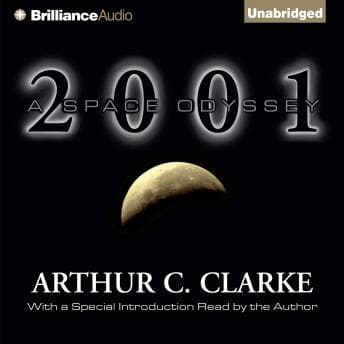

What happens when you finally read the book that inspired one of the most iconic films in cinema history? I mean, I've seen Kubrick's 2001 probably a dozen times. The monolith, the bone-to-spaceship cut, HAL's creepy eye - it's all burned into my brain. But Clarke's novel? Somehow never got around to it. (Yes, I know. I'm a fake nerd. My D&D group has already roasted me.)
So I finally fixed that. And honestly? The book hits different.
The Monolith in Your Ears
Here's the thing about Clarke's writing that the film can't quite capture: the why behind everything. Kubrick gave us visual poetry and existential dread. Clarke gives us the science. The detailed, meticulous, almost textbook-level explanations of how everything works. And I mean that as a compliment - this is Sanderson-level world-building before Sanderson was even born. The magic system here is physics, and Clarke treats it with the same reverence. That same reverence for detailed systems shows up in Eldest, where Paolini builds out his magic with almost scientific precision.
The journey from prehistoric Africa to Saturn's rings (yeah, Saturn - the book changed it from Jupiter) feels like a proper progression system. You're leveling up through human evolution, and the monolith is basically the universe's way of granting XP. My thesis can wait. This is the good stuff.
Dick Hill's narration suits this analytical tone surprisingly well. His voice has this clear, almost clinical quality that matches Clarke's scientific prose. When he's describing the mechanics of Discovery One or the logistics of deep space travel, it feels like listening to the world's most interesting professor. The pacing is deliberate - not slow, just... measured. Like the book itself.
HAL and the Voice That Haunts You
Okay, so let's talk about HAL 9000. Because this is where Hill really earns his paycheck.
His HAL voice is unsettling in the best way. There's this calm, almost melodic quality to it that makes the AI's descent into murderous logic feel inevitable rather than sudden. You hear the programming breaking down. You hear the conflict between directives. It's not the iconic Douglas Rain performance from the film, but it doesn't try to be. Hill found his own version of that artificial politeness masking something deeply wrong.
The character voices throughout are distinct enough that you always know who's speaking. Some listeners apparently found his melodic style jarring - I can see that. There's a musical quality to his reading that takes adjustment. But once you're in it? It works.
One genuine treat: Arthur C. Clarke himself reads the foreword. His voice is raspier, older, and hearing the man behind the monolith talk about his creation adds this layer of authenticity you can't get anywhere else. Worth the price of admission alone.
Where the Narrative Drifts
I'm not gonna pretend this is a perfect listen. The beginning with the prehistoric apes - Moon-Watcher and his tribe discovering the monolith - is fascinating conceptually but drags a bit in audio format. You're waiting for the jump to space, and you feel every minute of that wait.
And the ending? Look, the ending is the ending. It's trippy and philosophical and either you're into that or you're not. The Star Gate sequence is wild on the page, but without Kubrick's visuals, you're left with Clarke's attempts to describe the indescribable. It's ambitious. It's also where some listeners check out.
But that middle section - the Discovery mission, the tension with HAL, the slow realization that something is very wrong - that's where this audiobook sings. Hill's measured pacing builds dread like a slow burn campaign where you know the DM is planning something terrible.
Roll for Cosmic Enlightenment
This isn't a thriller. This isn't even really a character piece. It's a meditation on human evolution, our place in the cosmos, and what happens when we create intelligence we don't fully understand. Clarke wrote this in 1968 and the AI ethics stuff feels more relevant than ever. (My advisor would probably say I should write about that instead of procedural generation. He's probably right. I'm still not going to.)
At 6 hours and 44 minutes, it's a manageable commitment. Perfect for a road trip or a weekend of coding. The clean production means no weird audio issues pulling you out of the experience.
Who should listen: Kubrick fans looking for the complementary experience, classic sci-fi readers who somehow missed this one (like me), and anyone who wants their space opera served with hard science on the side. Who should skip: If you need fast-paced action and constant excitement, this slow, contemplative journey isn't your quest.
This is the good, slow, chewy sci-fi. The kind that makes you think about humanity's future while you're supposed to be debugging your thesis code. Worth every minute.