
What does a woman mean when she says she wants the past back—and whose hands does she imagine doing the washing? I was folding an old linen tablecloth at my kitchen table in Atlanta when Natalie Heller Mills’s domestic paradise began to look less like a home than a television set. I stopped matching the corners. Six children, eight million followers, hidden industrial appliances, and hired help kept outside the frame: that is quite a production to pass off as the natural order.
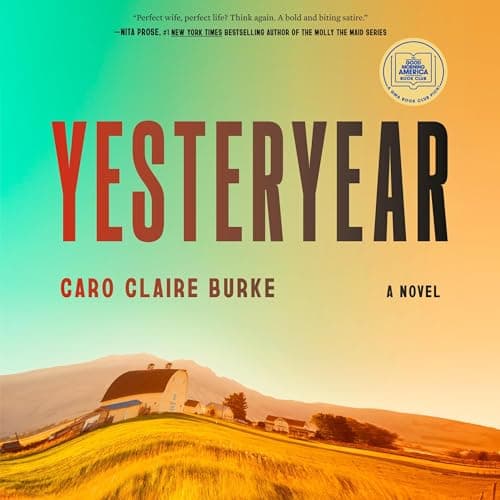
Caro Claire Burke’s Yesteryear takes that arrangement and removes its infrastructure. Natalie wakes in what appears to be 1855, with familiar people occupying horribly unfamiliar lives. Rebecca Lowman gives her the sharp, aggrieved authority of someone accustomed to controlling the description of everything—including herself. I found that voice entertaining. Then exhausting. Then entertaining for precisely the reasons it exhausted me.
The jam was never just jam
The most useful contrast here isn't between a telephone and a washboard. It's between domestic work as an image and domestic work as an obligation you cannot put down.
Natalie’s modern kitchen conceals commercial-grade equipment while her public persona celebrates homemade abundance. In her altered circumstances, a sputtering fire replaces electricity, laundry requires punishing physical effort, and firewood doesn't arrive because somebody has coordinated a delivery. Those details give Burke’s satire something firmer than an easy joke about an influencer losing her internet connection. Natalie has marketed the appearance of labor while concealing the systems that make her performance possible.
And the husband! His change from a soft-handed political heir to a capable farmer unsettles the bargain just as much as the kitchen does. The people around Natalie haven't merely lost their conveniences. Their competencies and relationships no longer obey her account of them.
After decades of teaching unreliable narrators, I don't require a protagonist to be pleasant company. I do require her self-deceptions to reveal something beyond her unpleasantness. Natalie clears that bar: her dismissal of critics as jealous “Angry Women” makes disagreement another accessory to her own importance. She can explain away almost anything. Watching that explanatory machinery struggle is much more interesting than simply waiting for her to receive a punishment.
Still, I kept returning to the date. As a Black woman, I cannot hear 1855 offered as a destination without asking who gets to call it simpler. That isn't a claim that this novel undertakes a comprehensive reckoning with that history. It's the question I brought to its premise, and one I wouldn't leave outside the door. Nostalgia always has a guest list.
Lowman lets Natalie prosecute her own case
Lowman’s chief achievement is making Natalie’s first-person account sound like an argument Natalie expects to win. The snark has purpose. It protects her from admitting bewilderment, dependence, or fear.
Compared with the emotionally neutral delivery that sometimes passes for restraint in suspense fiction, this is a more insistent performance. Lowman is capable of a quieter register—Last Thing He Told Me lets her hold a family’s secrets in a lower, more watchful voice—and the contrast helped me hear how much labor goes into Natalie’s insistence. Early on, I occasionally wanted Lowman to ease her emphasis and let the absurdity stand unassisted. Natalie already supplies plenty of pressure. But that insistence also suits a woman whose identity depends on maintaining her authority after the evidence has turned against her.
Supporting speakers remain distinguishable without becoming a procession of comic impersonations. More important, Lowman can move from domestic observation toward urgency without making the whole book sound like one prolonged alarm. The brutal injury in the woods raises the physical stakes beyond embarrassment or inconvenience; listeners sensitive to bodily harm should take that warning seriously. Lowman has narrated the body at its limits before—To Heaven and Back is her reading of a surgeon’s account of dying and returning—and her steadiness there made this scene land harder for me.
I listened at my customary 0.85x. That gave me room to consider Natalie’s language, though slowing the recording doesn't eliminate the wearing quality of her certainty. Nearly fourteen hours is a long acquaintance with someone so determined to be right. The middle also loosens its grip, and the shifts between timeframes ask for attention. This wasn't an audiobook I could leave running while answering messages.
Give Natalie your attention, not your allegiance
If you want the domestic-image scrutiny associated with Big Little Lies, there is a useful point of entry here—though Burke makes the machinery of public self-presentation much more overt. The attraction is watching a socially rewarded version of womanhood come under pressure, not finding a heroine you would invite to supper. Herman Koch has long kept such company—Dinner: A Novel builds an entire evening on the discovery that good manners can be the most damning performance in the house.
You get barbed social observation, an abrasive central consciousness, and uncertainty about whether Natalie's predicament is a hoax, a production, or something beyond either explanation. You give up steady thriller acceleration and the comfort of an agreeable guide. I was more invested in the collision between her beliefs and her bodily circumstances than in choosing among the possible explanations.
For that collision, and for Lowman’s sustained command of Natalie’s defensive voice, I'd spend a credit. Not without reservations about the middle stretch. But when the woman selling homemade jam must discover what her advertised life actually demands, Burke has found a question worth sitting still for.