
"We are the good parents. We are the parents who would do anything for our children."
That line hit me somewhere around hour three, and I had to pause the audiobook because I was standing in my kitchen making pancakes for my kids and the words just landed differently when you're looking at your own fifteen-year-old across the breakfast bar. Carlos gave me a look. I told him it was nothing. It was not nothing.
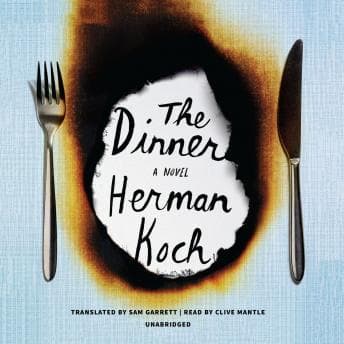
Herman Koch's Dinner is structured like an actual upscale dinner — Aperitif, Appetizer, Main Course, Dessert, Digestif — and at first you think the gimmick is going to be cute. It is not cute. Each course peels back another layer of what these two couples are hiding, what their sons have done, and how far they'll go to make it disappear. The slow drip of information is deliberate, almost clinical. You're getting the polite restaurant small talk up front — the pretentious menu descriptions, the social performance of ordering wine — and underneath all of it, something terrible is rotting.
The Narrator Who Made Me Uncomfortable (In the Right Way)
Clive Mantle does something interesting with Paul, our first-person narrator. His delivery has this edge of cheerful sarcasm, almost breezy, and for a while I thought it was a weird choice. Why is this guy so... upbeat? Then you start to realize Paul isn't a reliable narrator. He's not even close. And Mantle's oddly pleasant tone becomes part of the horror — you're listening to a man rationalize monstrous things in the voice of someone discussing weekend plans. It's unsettling in a way that creeps up on you.
I'll say this: the performance won't work for everyone. If you need a narrator to signal "this is the dark part now" with vocal shifts and dramatic pauses, Mantle doesn't give you that safety net. He keeps the same conversational warmth whether Paul is describing a restaurant bathroom or describing violence. And that's the point. But I can see how some listeners would find it grating or tonally off.
This Is Not How Families Talk About Crisis (Except It Absolutely Is)
Here's what Koch gets right, and what made me sit in my driveway for an extra ten minutes after one shift: the way these parents talk around the actual problem. The way they perform normalcy while their insides are screaming. I've watched families in my trauma center do exactly this — make small talk about parking while their kid is in the OR. Discuss lunch options while a social worker waits to have a conversation nobody wants to have. The avoidance is so real it made my chest tight.
What Koch also gets right is how quickly educated, progressive, civilized people will abandon every principle they claim to hold when their children are at stake. Paul's brother Serge is a politician — the kind of guy who makes speeches about doing the right thing. Watching (well, listening to) that facade crack course by course is brutal and satisfying.
But — and this is where I have to be honest — the pacing does drag in places. The restaurant descriptions, the flashbacks that circle back without always landing somewhere concrete. There were stretches in the middle where I found my attention drifting, and I don't think that's Mantle's fault. The book wants you to marinate in the discomfort, but sometimes marinating feels like waiting. I knocked the speed up to 1.15x around hour five and it helped.
Who This Dinner Is For (And Who Should Leave the Table)
If you're a parent, this book will mess with you. Period. It asks questions you don't want to answer and then sits there quietly while you squirm. If you like psychological thrillers that are more about moral collapse than body counts — if Gone Girl worked for you, if you like watching decent people make indefensible choices — this is your kind of dark. The slow erosion of a woman's identity under social pressure in My Brilliant Friend scratches a similar itch — different country, different decade, same suffocating feeling of watching someone choose wrong and understanding exactly why they did it.
Skip it if you need fast pacing or if unreliable narrators frustrate rather than fascinate you. Also skip if you want resolution that feels clean. This one doesn't wash off easy.
Carlos asked why I was crying in the car. I blamed allergies. But really it was that scene near the Digestif section, when you finally understand the full scope of what Paul is willing to do — and you realize you've been sympathizing with him for eight hours. That's the gut punch. Koch doesn't let you off the hook. You were complicit in this dinner, and now you have to sit with that.
Night Shift Prescription
Not a comfort listen. Not background noise. This is a 3 AM, unit-is-quiet, everyone's-stable kind of audiobook — the kind where you need your brain engaged and your moral compass spinning. Eight hours fifty-three minutes of slow-building dread disguised as a nice dinner out. Mantle earned that Earphones Award. And I need to call my mom and tell her I love her, even if she still thinks I should've been a doctor.