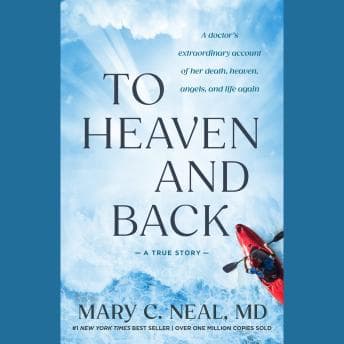

Okay so here's my complaint: this book made me cry in the middle of a Tuesday afternoon while I was designing a logo for a kombucha brand. A KOMBUCHA BRAND. I had tears running down my face and Frida was staring at me from the top of my monitor like I'd lost my entire mind, and I'm trying to get the kerning right on some hipster typeface while Mary Neal is describing the overwhelming peace she felt while literally drowning at the bottom of a Chilean waterfall. The audacity of this woman to wreck me like that while I'm on a deadline.
But let me back up.
When a Surgeon Talks About Surrender, You Listen
What got me about this book - and what I wasn't expecting - is that Mary Neal is not some soft-spoken mystic. She's an orthopedic spine surgeon. She talks about her near-death experience with this clinical precision that makes it hit harder, not softer. That same collision between rigorous analytical mind and something that can't be fully explained is part of what drew me to Isaac Newton — a man who spent his nights calculating the architecture of the universe and his private hours writing about prophecy and the nature of God. When she describes her kayak getting pinned underwater in the Los Rios region, she's matter-of-fact about the physical mechanics of drowning. The way her legs bent. The force of the water. And then she shifts into describing what happened on the other side, and the contrast between surgeon-brain and soul-experience is what broke me open.
Rebecca Lowman narrates this with exactly the right touch - warm but not saccharine, steady but not flat. She's got this sympathetic, clear American voice that feels like your favorite aunt telling you something important over coffee. She doesn't oversell the heaven sequences, which is crucial because that content could tip into cheesy SO fast with the wrong delivery. Lowman keeps it grounded and earnest. She lets Mary's words do the heavy lifting.
The Bible readings at the beginning of each chapter threw me at first - I wasn't expecting that structure. But they ended up working as these little breaths between sections, almost like chapter title cards in a telenovela. (Abuela would have loved this one. She would have been pressing play on this the second she heard "doctor dies and meets angels" and then she would have called every single person at her church to tell them about it.)
The Faith Thing - An Honest Reckoning
Look, I grew up Catholic. I have complicated feelings about organized religion. I went into this book a little guarded, expecting it to feel preachy or like a sales pitch for a specific brand of Christianity. And... it does lean heavily into Christian theology. That's just real. Mary frames everything through her relationship with Jesus and her understanding of God's plan, and there are stretches where it reads more like a devotional than a memoir.
But here's what kept me: her grief is real. Her confusion is real. She didn't WANT to come back. She describes this deep sadness at being pulled away from whatever she experienced in that space between life and death, and that part - the ache of being sent back to a life full of suffering when you've tasted something beyond it - that transcended any theological framework for me. That's just a human being trying to make sense of something impossible.
At under five hours, this is a compact listen. No filler. No padding. Mary tells you what happened, tells you what she believes it means, and lets you sit with it. I appreciated that she didn't stretch it into some bloated 12-hour spiritual autobiography.
Who This Is (and Isn't) For
If you're looking for hard scientific analysis of near-death experiences, this isn't it. Mary is a scientist by training but this is a faith memoir, full stop. If you're hostile to Christian perspectives, you'll bounce off this fast. But if you're someone who carries grief - who lost someone and lies awake wondering where they went - this book feels like a warm hand on your back. It doesn't answer every question. It doesn't try to. It just says: I was there, and it was beautiful, and I believe we'll see each other again.
I listened to the last chapter while lying on my couch in the dark because it felt wrong to multitask through it. Diego curled up on my chest and I just... let it wash over me. Two years without Abuela and I still reach for my phone to call her sometimes. This book didn't fix that. Nothing fixes that. But it gave me something soft to hold onto for a few hours, and some days that's enough.
The Kind of Book You Keep On Your Shelf Like a Candle
This book felt like sitting in Abuela's living room with the windows open and the rosary beads clicking. It's not perfect. The theological sections can feel a little repetitive, and I wanted more sensory detail about her experience rather than interpretation of it. But Rebecca Lowman's steady, gentle delivery carries it through the slower stretches, and Mary's sincerity is undeniable. This is a rainy Sunday book. Light a candle, close your laptop, and just listen.