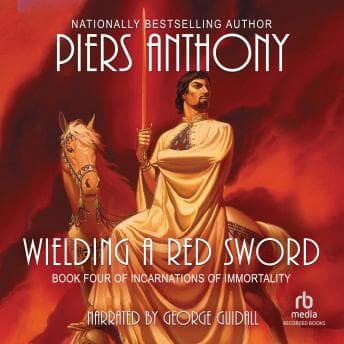

Piers Anthony's Incarnations of Immortality series is basically D&D's cosmology if someone actually sat down and wrote the Player's Handbook for it. And Wielding a Red Sword? This is the Mars sourcebook.
I was supposed to be debugging my procedural terrain generator at 2 AM. Instead I was listening to an Indian prince become the literal god of War while my laptop screen dimmed from inactivity. Dr. Patel would be disappointed. I regret nothing.
When Your Berserker Rage Is Actually a Job Qualification
Mym stutters. That's the first thing you need to know. An Indian prince with a speech impediment who can only speak clearly when singing—and when he goes full berserker mode. Anthony takes this premise and runs with it in ways that feel genuinely inventive. When Mym ascends to the mantle of Mars, his stutter becomes irrelevant because War doesn't need to explain itself. The Red Sword just is.
The magic system here—and yes, I'm using that phrase because Sanderson didn't invent caring about how fantasy mechanics work—operates on allegorical logic. Tower Lord does something similar with its blood-song magic, giving each power clear costs and constraints. Each Incarnation (Death, Time, Fate, War, Nature, Evil, Good) has specific domains and limitations. Mars can influence battles but can't just snap his fingers and end all conflict. There are rules. There's a bureaucracy of the divine. My D&D group would absolutely try to min-max this system, and honestly? Anthony gives you enough scaffolding that you could.
The East-meets-West mythology blend works better than it has any right to. Mym brings Hindu cosmological sensibilities to a framework that's mostly Western in structure, and the tension between those worldviews becomes part of the actual plot rather than just window dressing.
George Guidall Walked So Fantasy Narrators Could March
Look, Guidall isn't doing Steven Pacey-level character differentiation here. That's not what this performance is. What he's doing is lending gravitas to material that could easily tip into camp. When Mym makes his whispered vows or when the battle cries hit, Guidall treats them with the same dignity he'd give to literary fiction. The man has three Audies for a reason.
His approach to the female characters—particularly Rapture, Mym's betrothed who becomes his companion in the office of War—avoids the trap of making them sound like caricatures. In a Piers Anthony book from 1986, that's not nothing. The romantic scenes land because Guidall commits to the emotional beats without overselling them.
The production is clean. No sound effects, no music, just Guidall and the text. Ship of Destiny takes the opposite approach at over 30 hours, but both prove that length matters less than whether the narrator can sustain your attention. At 10 hours, Wielding a Red Sword is a comfortable listen—substantial enough to feel like a real commitment but not the 40-hour epic fantasy marathons I usually gravitate toward.
The Weakest Link in a Strong Chain
Here's where I have to be honest: this is widely considered the weakest entry in the Incarnations series. And... yeah, I can see it. The pacing in the middle section drags compared to On a Pale Horse's propulsive mystery or Bearing an Hourglass's time-manipulation puzzles. Mym's character arc is less surprising than his predecessors' journeys.
But "weakest in a good series" isn't the same as "bad." It's more like... the Empire Strikes Back problem in reverse. When you're following up strong entries, even a solid installment feels like a step down. The Satan confrontation that the whole book builds toward delivers, but the path there meanders more than it needs to.
Anthony's prose is workmanlike—functional rather than beautiful. He's not here to dazzle you with sentences. He's here to build a world where War is a job with HR problems and office politics, and then explore what that means. If you don't like info-dumps, this isn't for you. (But you're wrong.)
Who Gets Conscripted, Who Gets Exempted
This is for you if: You're already invested in the Incarnations series. You like your fantasy with systematic magic and clear cosmological rules. You appreciate when authors actually think through the implications of their premises. You want something meaty but not overwhelming for a week of commutes.
Skip this if: You need fast pacing throughout. You're looking for a standalone entry point to the series (start with On a Pale Horse instead). You want your fantasy narrators doing full character voice differentiation.
Roll for Initiative on Your Next Credit
Wielding a Red Sword isn't the best Incarnations book, but it's a necessary piece of one of fantasy's more underrated cosmological puzzles. Guidall's narration elevates material that could feel dated, and the core concept—what if War was a person who had to actually manage conflict rather than just embody it—remains genuinely interesting.
I finished it at 4 AM. My thesis remains unwritten. The Stormlight Archive is calling. But I don't regret the detour. Sometimes you need a 10-hour reminder that the 80s produced some genuinely weird and wonderful fantasy we've collectively forgotten about.
My D&D group would love this. I'm making them listen to it before our next campaign.