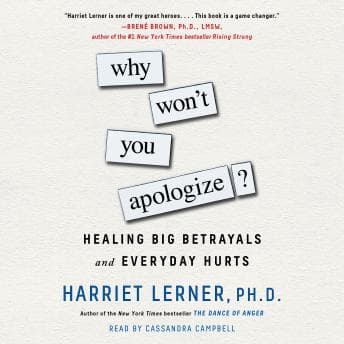

I need to rant about something. Harriet Lerner spends the first chapter dismantling the phrase "I'm sorry you feel that way" and I physically winced because I have used that exact line in at least four client calls this year. Possibly five. My wife Jenny would know the exact number because she keeps a mental spreadsheet of my emotional failures, which - ironically - is basically the thesis of this book.
I was prepping a deck for a founder meeting at midnight, half-listening, when Lerner dropped her distinction between apologizing and "un-apologizing" - those sneaky sorry-not-sorry constructions where you slip a "but" or an "if" into what should be a clean two-word statement. She breaks down how "I'm sorry, BUT you also need to understand..." instantly cancels everything before the conjunction. This is what my parents did instinctively. My mom at the dry cleaners would just say "We fix it, no charge" when something went wrong. No qualifiers. No explanations about how the customer's fabric was already compromised. Just ownership. Now it has a TED talk.
The Framework That Actually Earns Its Pages
At 4 hours and 37 minutes, this book does something I almost never see in self-help: it respects your time. Lerner has maybe three core ideas - what makes a genuine apology, why certain people are constitutionally incapable of giving one, and how to stop being the person who apologizes for existing (the over-apologizer chapter hit different). She doesn't pad them. She illustrates each with clinical stories from her therapy practice - real couples, real betrayals, real conversations. The attachment patterns underneath those betrayals reminded me of what Anxiously Attached maps out - both books are essentially diagnosing why certain people can't give you what you're asking for, and why you keep asking anyway. One that stuck: a woman whose husband had an affair and kept saying "I've apologized a hundred times, what more do you want?" Lerner's breakdown of why repetition isn't the same as reparation was genuinely sharp. The guy was performing remorse like a quarterly earnings call - hitting all the right notes without actually changing the numbers.
The key takeaway is worth the listen: a real apology requires you to actually sit in the other person's pain without centering yourself. That sounds obvious until you realize how rarely anyone actually does it. Lerner's framework for what she calls the "good enough" apology - where you don't have to grovel but you do have to resist the urge to defend or explain - is something I've already started using with clients. One founder I work with has been locked in a co-founder dispute for eight months. Sent him the Audible link yesterday.
When Forgiveness Gets Weaponized
Here's where the book gets genuinely interesting and separates itself from every other apology-adjacent self-help title. Lerner pushes back hard on the forgiveness industrial complex - the idea that you MUST forgive to heal, that holding onto anger is "drinking poison," all those Instagram-ready platitudes. She argues that pressuring someone to forgive before they're ready is its own form of harm. That the injured party gets to decide the timeline. Period.
I've seen this play out in business contexts constantly. A startup CEO makes a terrible hiring decision, fires someone badly, then wants the whole team to "move forward" by the next all-hands. That pressure to skip past legitimate grievance? Lerner would call it a second injury. And she'd be right. I've seen this fail at three different companies where leadership wanted reconciliation on their timeline, not the team's.
Cassandra Campbell's narration is calm to the point of being almost therapeutic - like a really good couples counselor who doesn't take sides. Her delivery is measured and warm without being saccharine, which matches Lerner's clinical-but-accessible tone. She doesn't dramatize the patient stories, just presents them clearly. For a book about emotional pain, the production stays remarkably even-keeled. No performance fireworks, but honestly, this material doesn't need them. You need to actually absorb these ideas, not be entertained by them.
Who Gets the Invoice
If you're a non-apologizer - and you probably don't think you are, which is Lerner's whole point - this book will make you uncomfortable in productive ways. If you're the over-apologizer (hi, every woman I've ever managed), the chapter on distinguishing between genuine remorse and reflexive people-pleasing is worth the listen alone. Skip to chapter 5 if you're short on time. Thank me later.
If you're looking for a business book disguised as a relationship book, this is it. Every negotiation, every difficult conversation with a direct report, every board meeting where someone screwed up - apology mechanics are operating underneath all of it. Lerner just gives you the vocabulary.
Jenny would say I'm being harsh if I gave this anything less than a strong recommendation. Jenny is right.
Bottom Line: Worth the Credit, Won't Waste Your Evening
Finally, a business book - okay, a psychology book, but same difference in my world - that respects your time. Under five hours, actionable framework, no fluff chapters about the author's childhood revelation on a mountaintop. My 2.0x speed wasn't even necessary here, though I used it anyway because I am who I am. Lerner wrote a tight book. Campbell narrated it cleanly. And I have three apologies to make this week that I've been avoiding. So. There's that.