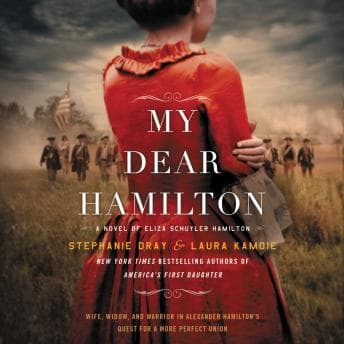

There's a moment in this book—somewhere around the halfway mark of this 23-hour marathon—where Eliza realizes she's married to a man who is essentially a walking, talking risk factor. He's brilliant, sure. But he's volatile. And she's the one doing the risk management.
(This is why I tell my startup founders to marry someone grounded. You need a hedge against your own ego.)
I picked this up because Jenny bet me I couldn't finish a "historical romance" without rolling my eyes. Joke's on her—this isn't a romance. It's a crisis management case study disguised as a period drama.
THE COO BEHIND THE BRAND
Let's be real about Alexander Hamilton. If he were alive today, he'd be the CEO of a unicorn tech startup, tweeting things at 3 AM that tank the stock price. He's the "visionary."
Eliza? She's the COO. The Operations Manager. The one actually running the business while Alexander is out there starting beef with Jefferson.
Dray and Kamoie did their homework here. They dug through thousands of letters (the receipts, basically) to show that Eliza wasn't just sitting around needlepointing while history happened. She was in the trenches. The descriptions of the war, the poverty, the absolute grind of building a nation from scratch—it reminded me of my parents' dry cleaning shop. Where the Crawdads Sing has that same texture—Campbell narrates both, and she brings the same weight to stories about women doing the unglamorous work of survival. Unsexy, relentless work. The stuff that actually builds a legacy.
The betrayal part—the Reynolds Pamphlet—is handled with brutal honesty. It's the ultimate PR nightmare. Watching Eliza navigate that public humiliation while trying to keep her family (and her husband's career) intact? That's grit. That's the hustle nobody puts on Instagram.
THE AUDIO ROI
Here's the thing about 23-hour audiobooks: usually, they're bloated. I went in ready to skip chapters. I didn't.
Cassandra Campbell is the narrator. I haven't listened to her before, but she's a pro. Usually, I crank fiction to 2.5x speed because I just want the plot points. With Campbell, I actually dialed it back to 1.75x. (Yes, that's slow for me. Don't judge.)
She does this thing where she differentiates the voices without doing cartoonish impressions. Her Alexander sounds frantic and sharp; her Eliza sounds steady but tired. You can hear the exhaustion in her voice as the years pile up. It's not just "reading"—she's acting the hell out of it.
If I have a complaint, it's that the middle section drags a bit. There's a lot of political maneuvering that feels like being stuck in a board meeting that should've been an email. But Campbell keeps the energy up enough that I didn't zone out.
WHO SHOULD INVEST THE 23 HOURS
This one's for you if you want the unvarnished story behind the musical—the P&L statement, not the marketing brochure. Skip it if you're looking for a light listen or can't stomach political maneuvering that occasionally reads like meeting minutes.
CLOSING THE BOOKS
Look, if you only know Hamilton from the musical, you're getting the marketing brochure version. This book is the P&L statement. It shows the losses, the debts, and the sweat equity.
It's long. It's heavy. Not a light beach read. But if you want to understand the operational overhead of being a "Founding Father," this is it. Eliza Schuyler Hamilton was the ultimate fixer.
Jenny asked if I cried at the end. I told her I had allergies. We left it at that.