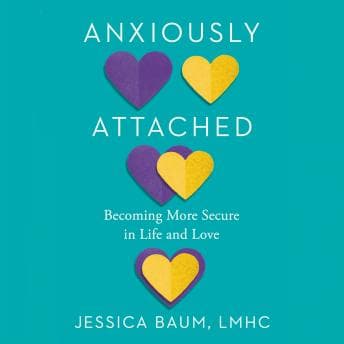

Look, I need to complain about something first: why do self-help audiobooks always assume you're listening in a peaceful meditation room with a lavender candle and zero notifications? I'm on the 6:47 AM Caltrain, wedged between someone's laptop bag and a guy who apparently doesn't believe in headphones. That's where I processed my attachment style issues, thank you very much.
But here's the thing - Jessica Baum's voice actually cut through the chaos. And I mean that literally. Her narration has this clinical-but-warm quality that made me feel like I was in a therapy session I couldn't afford in the Bay Area. (Seriously, have you seen what therapists charge here? This audiobook is basically 9.5 hours of sessions for one credit.)
The ROI Breakdown
Bottom Line: Worth your commute if you've ever spiraled over a text that took 3 hours to get a response.
Baum's "Self-full Method" - yes, that's trademarked, which made me roll my eyes initially - actually has substance behind the branding. She breaks down the anxious-avoidant dance with the kind of systematic clarity my engineer brain appreciates. You know how some relationship books are all vibes and no framework? This one has actual structure. She walks through why anxious attachers tend to lose themselves in relationships, then gives you concrete tools to build what she calls "self-sovereignty."
The framework is basically: understand your attachment wounds → develop internal stability → communicate needs without the desperate energy → build interdependence instead of codependence. Simple to explain, obviously harder to execute. But she doesn't pretend it's easy, which I respect.
When the Author IS the Narrator
So here's where author-narrated audiobooks usually lose me. Most authors are not voice actors. They read their own words like they're giving a conference presentation, all flat affect and weird pauses.
Baum is different. She's a practicing therapist, and you can tell. Her delivery has this quality where she sounds like she's actually talking TO you, not AT you. When she discusses childhood attachment patterns and how they show up in adult relationships, there's genuine compassion in her voice - not performative "I'm being empathetic now" energy. It genuinely feels like having a one-on-one session, which makes the personal excavation parts easier to sit with.
The meditation practices she includes? Those I saved for home. Could not do guided breathing exercises on a packed train without someone calling BART police. But they're well-integrated, not just tacked on at the end like some books do.
The Part Where I Got Called Out
I'm going to be honest: I picked this up because Kevin and I had a fight about me checking his location on Find My Friends "too often." (His words. I maintain it was reasonable.) Somewhere around hour 4, Baum started describing the anxious attachment tendency to seek constant reassurance and interpret any distance as rejection, and I had to pause the audiobook because I felt personally attacked.
The section on boundaries was particularly useful - not just "set boundaries" (thanks, every self-help book ever) but specifically how anxious attachers struggle with boundaries because they fear abandonment if they assert needs. She gives scripts for communicating with partners, which - as someone who debugs code all day - I appreciate. Give me the syntax, you know?
Who Should Listen (And Who Should Skip)
This is focused listening material. You can't have this on in the background while you're coding because you'll miss the frameworks. But it's not so dense that 6 AM brain can't process it. I finished it in about 4 commutes, listening at 1.5x (her pacing is calm enough that speeding up doesn't lose clarity).
Grab this if: You've ever been called "too much" or "too needy" in relationships. You're aware you have anxious attachment patterns but haven't found a practical framework for working on them. Your partner is avoidant and you're stuck in that push-pull cycle.
Skip if: You're looking for couples exercises to do together - this is more individual-focused. Or if you want pure science; she references attachment research but this is more therapeutic framework than academic deep-dive. For the research-heavy approach, try "Attached" by Levine and Heller first. If you want something that tackles self-work from a different angle, Self-Reliance offers a more philosophical take on building internal stability.
The Debug Report
At 9.5 hours, it's a reasonable commitment. Could some sections be tighter? Sure. There's some repetition of core concepts that felt like padding. But unlike business books that could've been blog posts, this one earns its length with the meditation practices and detailed case examples.
The ROI here is solid if you're actually going to do the work. It's not a magic fix - Baum is clear about that. But it's a well-structured roadmap from someone who clearly knows the territory. I've already recommended it to two friends who are in that anxious-avoidant spiral, and I texted Kevin an apology about the Find My Friends thing.
Progress, I guess.