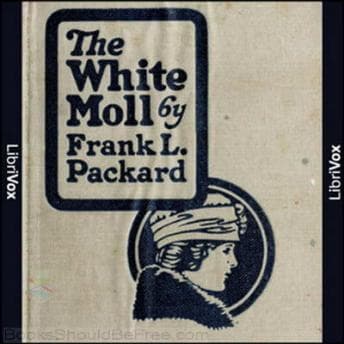

Frank L. Packard wrote The White Moll in 1920, and it sounds like 1920. That's not a complaint - it's a confession that I was absolutely not prepared for how much I'd enjoy a century-old pulp thriller about a woman navigating the criminal underworld of New York while disguised as a dead opium addict.
Let me back up.
Rhoda Gray Deserved Better (And She Knows It)
I was shelving returns at the library on a slow Tuesday afternoon, earbuds in, half-listening the way you do when you think you know what a book is going to give you. Old-fashioned mystery, some dated language, predictable beats. Then Rhoda Gray - "The White Moll," a woman known in the slums for her charity work - stumbles into Gypsy Nan's garret and finds a dying woman who is absolutely not a gypsy, not a beggar, and not who anyone thinks she is. And from that moment, Rhoda has to become Gypsy Nan. Live in her filthy rooms. Wear her rags. Interact with a criminal gang who believes she's one of them. All while the police are hunting her for a crime she didn't commit.
Here's what got me: the book doesn't let Rhoda be passive about any of this. She's making tactical decisions in real time - which identity to wear, which lie to tell, how to sabotage the gang's operations from the inside without blowing her cover. The rogues' gallery is ridiculous in the best way - Pierre Dangler, Pinkie Bonn, Skeeny, the Sparrow - names that belong on a wanted poster in a speakeasy. And "the Adventurer," the mysterious figure pulling strings from the shadows, functions as the kind of unseen threat that's way more effective than any monster. Shirley Jackson walked so... okay, different genre. But Packard understood dread. The constant threat of exposure, the claustrophobia of pretending to be someone you're not in rooms full of people who would kill you if they knew - that's horror-adjacent, and I'm claiming it. That specific flavor of dread - identity as trap, exposure as death sentence - is something Stephen King explored from a very different angle in Skeleton Crew: Selections, and I kept thinking about the two in conversation while Rhoda sweated through another room full of people who'd gut her if they knew the truth.
Rowdy Delaney's Low-Key Gamble That Pays Off
So here's the thing about narrating pulp. You can go big - lean into the melodrama, chew the scenery, give every gangster a gravel-voiced caricature. Or you can do what Rowdy Delaney does, which is play it straight. Almost eerily straight. The narration is low-key in a way that initially made me wonder if he was under-performing the material, but by the second hour I realized the restraint is the point. When Pierre Dangler is threatening Rhoda and Delaney doesn't raise his voice, doesn't ham it up, the menace lands harder because it feels matter-of-fact. Like violence is just Tuesday for these people.
The action sequences - and there are genuine shoot-outs and chase scenes in this thing, which surprised me for 1920 - come through with intensity precisely because Delaney hasn't been yelling for the previous three hours. He earns his peaks by keeping the valleys quiet. It's not a showy performance. You won't clip moments and share them. But it serves the story honestly, and for a solo narration of a book with this many colorful characters, that's a smart choice.
I will say: the character differentiation isn't always crystal clear. With names like Skeeny and the Sparrow and Pinkie Bonn, you want voices that are as distinct as the names suggest, and Delaney doesn't always deliver that. There were a couple of scenes where I had to rewind to figure out who was speaking. Not a dealbreaker, but noticeable.
The 1920 of It All
Look - the prose is dated. Packard writes in a style that loves its own sentences, and some of the dialogue reads like stage directions rather than things humans would actually say. At 8 hours and 46 minutes, there are stretches where the plotting circles back on itself, and you can feel the serial-fiction DNA (this was the era of magazine installments, and it shows). I bumped the speed to 1.25x around hour five and didn't lose anything.
But there's something genuinely thrilling about hearing a proto-noir thriller that predates Dashiell Hammett. You can hear the genre being born. Packard is building the architecture that hardboiled fiction would later inhabit, and Rhoda Gray - a woman as the central figure in a crime thriller in 1920 - feels ahead of her time in ways that made me want to dig through the stacks for more of his work.
If you scare easily... well, this isn't horror. But if you want a thriller that understands tension, that uses disguise and deception as its primary weapons, and that features a protagonist who is smarter than every man in the room (they just don't know it yet), this is a genuinely fun listen.
File Under: Hidden Stacks, Worth the Dig
My podcast listeners are going to love this - not because it's a horror recommendation, but because it's a genre-history recommendation. This is the connective tissue between Sherlock Holmes and Sam Spade, and hearing it performed rather than reading it on a screen strips away the century of dust and lets the story breathe. Shirley (my cat) was unimpressed. But she's unimpressed by everything that isn't a can opener.