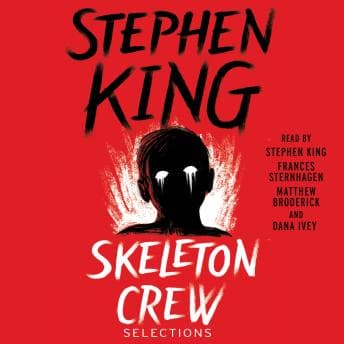

Everyone told me Stephen King's short stories hit different. That they're tighter, meaner, more psychologically ruthless than his doorstop novels. I was skeptical. I'm a character psychology person—I need time to understand why people do terrible things. Five hours didn't seem like enough runway.
I was wrong. Spectacularly, unsettlingly wrong.
I started this collection while making dal at 10 PM, the kind of elaborate cooking project I undertake when my brain won't stop analyzing research data. By the time I got to "The Jaunt," I'd burned the onions and didn't care. By "Gramma," I'd abandoned the kitchen entirely and was just standing in my dark living room, phone pressed to my ear like a teenager hiding from her parents.
Four Narrators, Four Psychological Textures
Here's what fascinated me about this production: four narrators, each bringing completely different psychological textures to King's work. Matthew Broderick—and look, I understand the criticism that his celebrity status is distracting—actually brings this almost naive quality to his stories that makes the horror land harder. You trust him. That's the trap.
Frances Sternhagen handles "Gramma" with this grandmother-adjacent warmth that makes the reveal absolutely devastating. Listeners have reported crying when the grandmother's true intentions surface, and I get it. I didn't cry (my therapist would be proud), but I did have to pause and stare at my ceiling for a solid minute.
Dana Ivey brings theatrical precision. Stephen King reading his own work is... well, it's King. Rough around the edges, Maine accent thick as fog, but authentic in a way that polished narration can't replicate.
The weakness? Some pacing issues in longer segments, and apparently there are audio skipping problems in certain versions. I didn't encounter skips, but the pacing critique tracks—"The Mist" drags in spots where a single narrator might have pushed through faster.
Ordinary Minds at Their Breaking Points
What makes this collection compelling is King's understanding of ordinary psychological breaking points. "Survivor Type" isn't really about a man stranded on a desert island. It's about the incremental rationalizations we make when survival instinct overrides moral framework. The protagonist exhibits classic cognitive dissonance resolution—each terrible choice becomes logical in context. That same psychological unraveling—watching someone rationalize the irrational—shows up in Les Miserables, where Javert's rigid moral framework collapses under the weight of cognitive dissonance.
"Mrs. Todd's Shortcut" fascinates me because it's essentially about obsession disguised as whimsy. A woman finds increasingly impossible routes that shave minutes off her drive. The psychology here is addiction behavior mapped onto something mundane. My therapist would have thoughts about Mrs. Todd.
"The Monkey" works because King understands that childhood terror isn't about the monster—it's about the helplessness. The twist lands because it's psychologically inevitable, not because it's surprising.
The Broderick Problem (Or Non-Problem)
Some listeners found Matthew Broderick's narration engaging. Others found it distracting. I found myself asking: why does celebrity recognition actually interfere with horror immersion?
Here's my theory. Horror requires vulnerability. When you recognize a voice as "Ferris Bueller," you're pulled into a different psychological space—nostalgia, familiarity, safety. The horror has to work harder to break through that protective association.
For me, it worked. But I can see how it wouldn't for everyone. If you're the type who can't watch a movie without saying "oh, that's the guy from that thing," maybe this isn't your version.
What Five Hours Actually Delivers
This is a "Selections" edition, which means you're not getting the full collection. You're getting curated highlights—"The Mist," "The Jaunt," "Gramma," "Mrs. Todd's Shortcut," and others. It's a sampler platter of King's range: cosmic horror, domestic terror, psychological dissolution, dark fantasy.
The multi-narrator approach means each story feels distinct. You're not getting narrator fatigue. But you're also not getting the cohesion of a single voice threading everything together.
At 1.25x speed, the horror elements actually land better—there's more urgency, less time for your rational brain to interrupt with "this is fiction." Worth trying.
Your Prescription
Listen if: You're a King fan who wants variety, a horror listener who gets bored with single-narrator collections, or you're curious about King's short form work before committing to a full novel.
Skip if: You need consistent narration style, celebrity voice recognition pulls you out of stories, or you want the complete collection—this is selections only.
The production has some rough edges—name mispronunciations crop up, and the pacing isn't always tight. But the psychological texture of these stories? That's pure King. He understands the ordinary ways we rationalize, obsess, and ultimately break.
Case Closed
I went in skeptical about short-form King. I came out understanding why this collection won the Locus Award. It's not about the monsters. It's about the minds that create them, fear them, and sometimes become them.
My dal was ruined. Worth it.