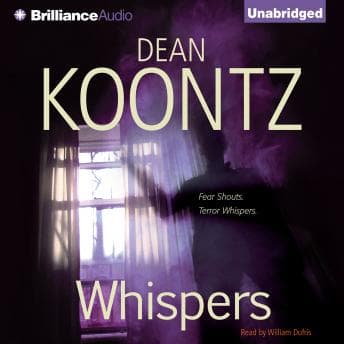

Everyone kept telling me Koontz was the master of psychological horror. That Whispers was a classic. That I'd be gripped from the first chapter. So I queued it up during a late-night cooking session—something elaborate, lamb biryani, the kind of dish that takes hours and leaves you alone with your thoughts. Perfect for a psychological thriller, right?
Except here's the thing: I spent more time analyzing why the narrator's choices weren't working than I did feeling genuinely unsettled.
The Case Study That Almost Was
Let me be clear about something: the source material here is genuinely fascinating from a psychological perspective. Bruno Frye exhibits classic patterns of developmental trauma manifesting in adulthood—the adopted mother's abuse creating a psychological architecture that persists long after her death. Those whispers he hears? That's not just gothic atmosphere. That's internalized parental voice becoming psychotic symptom. Koontz actually understands how childhood terror calcifies into adult pathology.
And Hilary Thomas as a survivor navigating the aftermath of attack? The research shows that victims often struggle more with the randomness of violence than the violence itself. Koontz gets this. The story has psychological bones.
But here's where I found myself asking: why does this audiobook version feel so... flat? I had a similar disconnect with Haunted—compelling psychological material that didn't quite land in audio format.
When "Macabre" Becomes the Real Horror
William Dufris pronounces "macabre" phonetically. Every. Single. Time. It's "muh-KAH-bray," not "muh-KAB-er," and in a book that's trying to build dread and atmosphere, this pronunciation choice yanked me out of the narrative like a fire alarm during a séance.
But that's honestly the least of the problems. The character work here feels—and I'm trying to be generous—stereotypical. Bruno should feel like a genuine case study in dissociative pathology. Instead, his voice comes across as "generic crazy person" rather than someone whose internal logic makes terrifying sense to him. Psychologically, this doesn't track. The most frightening villains are the ones whose motivations feel internally consistent, even when they're doing monstrous things.
Dufris has moments of expressive delivery, particularly during high-tension scenes. But there's a flatness underneath it all that bleeds through. Like listening to someone describe a nightmare they had three weeks ago rather than experiencing one in real time.
Eighteen Hours Is a Lot to Ask
At nearly nineteen hours, this is a commitment. And commitment requires trust in the narrator to carry you through the slow-burn sections. The plot moves—Hilary's attacks, Bruno's pursuit, the gradual revelation of what made him this way. But the pacing feels elongated when the vocal performance doesn't match the story's internal urgency.
My therapist would have thoughts about this character—Bruno, I mean. The way maternal abuse shapes his relationship to women, the way he can't distinguish between past and present threat. These are patterns I've studied. Patterns that should make me lean in. Instead, I found myself mentally rewriting how the narration should sound while stirring my biryani. In the Blood explores similar maternal trauma patterns, though with a narrator who actually understood the psychological weight.
(The biryani turned out great, by the way. Small victories.)
Who Should Queue This Up—And Who Should Skip
Koontz completists, you'll want this for the collection. The story itself is a classic for a reason—solid character development, genuine psychological insight, and that particular Koontz blend of horror and thriller that influenced an entire generation of writers.
But if you're coming to audiobooks for the performance? If you want a narrator who makes you forget you're listening rather than reading? This might frustrate you. Especially at this length. Skip it if pronunciation errors and uneven character voices pull you out of stories.
Speed recommendation: 1.25x helps with pacing and makes some of the more overplayed moments feel less... much. Though it won't fix the pronunciation issues.
Case Closed, Patient Discharged
What makes Bruno Frye compelling is exactly what the audiobook undersells: he isn't random evil. He's manufactured evil, created by systematic abuse, operating on a logic that makes sense within his fractured psychology. Hilary isn't just a victim—she's a survivor whose response to trauma is worth studying.
Koontz wrote a psychological thriller that actually earns the "psychological" part. The audiobook version just doesn't quite do the case study justice.
I finished it. I don't regret the time. But I kept thinking about how much more effective this would be with a narrator who understood that sometimes restraint is scarier than performance. That sometimes the whispers should actually whisper.