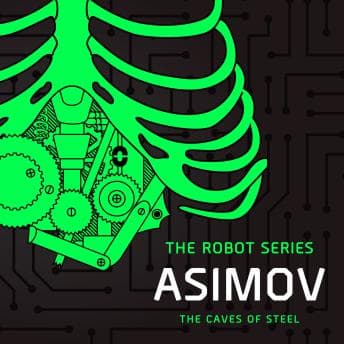

Isaac Asimov wrote a locked-room mystery set inside a city that is itself a locked room. That's the kind of structural elegance that makes me want to grab my students by their AirPods and say this is why we still read the classics.
Caves of Steel dropped in 1954, and it shouldn't work as well as it does seventy years later. A detective story fused with science fiction, where the murder investigation is almost secondary to the real question Asimov keeps circling: what happens when a species builds something smarter than itself and then resents it for existing? I caught myself pausing during a late-night grading session — red pen hovering over some poor kid's five-paragraph essay about symbolism in Lord of the Flies — because Lije Baley had just articulated something about fear of obsolescence that hit me harder than any thriller twist could.
This is Asimov doing what Asimov does best: using genre machinery to smuggle in genuine philosophical weight.
The City as Character (And the Character as City)
Here's what struck me on this listen that I'd somehow glossed over reading the novel years ago: Asimov's New York isn't just a setting. It's a psychological condition. Eight billion people crammed under steel domes, eating in communal kitchens, terrified of open sky. Baley's agoraphobia isn't a quirk — it's a species-wide trauma response dressed up as civilization. The book spends real time making you feel the claustrophobia of a humanity that chose enclosure over exploration, and Dufris's narration leans into it. His Baley sounds like a man whose jaw is permanently clenched. There's a gruffness, a compression to the voice, like someone who's spent decades breathing recycled air and thinking small thoughts about big problems.
And then R. Daneel Olivaw walks in — soft-spoken, polite, unsettlingly human — and Dufris shifts into something quieter, more measured. The contrast works beautifully. You hear the class divide, the species divide, before Asimov even explains it. Baley sounds like he's fighting the world. Daneel sounds like he's observing it. This reminds me of what Hemingway said about the iceberg theory — so much is happening beneath what's actually spoken.
Where Dufris Stumbles (And It's Worth Mentioning)
Look, I'll be honest. The female voices are a problem. Jessie Baley comes across as shrill in a way that feels more caricature than character, and it pulled me out of scenes that should've carried real emotional weight. Jessie's confession scene — which is one of the book's genuine turning points — lands about sixty percent as hard as it should because the voice performance turns her into something closer to a cartoon wife than a frightened woman caught in circumstances beyond her control.
It's the one consistent weak spot. Dufris commands everything else — the bureaucratic tension of Commissioner Enderby, the arrogance of the Spacers, the nervous energy of Baley's internal monologue. But every time a woman speaks, there's this wobble where you're suddenly aware you're listening to a man doing a voice. My students would hate this. I love the rest of it enough to forgive it, but I won't pretend it isn't there.
Asimov's Real Mystery Isn't the Murder
Here's what the author is really saying, and what the audiobook format actually clarifies: the whodunit is almost a Trojan horse. Asimov cares far more about the evolving relationship between Baley and Daneel than about who killed Dr. Sarton. The murder gets solved — fine, good, the mechanism is clever enough — but the real payoff is watching a man who hates robots slowly, grudgingly, begin to see one as a partner. Maybe a friend. The narrator understands that pause is punctuation. Dufris gives Baley these tiny hesitations in the later chapters, beats where you can hear the character reconsidering his prejudices in real time. That's performance art.
At seven hours and forty-four minutes, the pacing is tight. No bloat. Asimov was never one for lyrical prose — the man wrote like an engineer drafting blueprints — but that precision translates surprisingly well to audio. The prose deserves to be savored, even when it's spare. Especially when it's spare.
I finished it on a Sunday walk along the lakefront with Denise. She asked why I was smiling. I told her a robot from 1954 just made me rethink my relationship with technology. She said that tracked.
Who Gets the Assignment
If you loved Asimov's Foundation but wished it had a beating heart at its center, this is its spiritual successor — or really, its predecessor, since the Robot novels came first. Mystery fans who don't think they like sci-fi: start here. Sci-fi fans who skip mysteries: also start here. Golden Son is another one that earns readers from both camps — the sci-fi machinery is propulsive enough for genre loyalists, but the political intrigue and character betrayals hit like a thriller. If you need lush world-building with pages of description, Asimov will frustrate you. He tells, he doesn't paint. But if you want ideas that burrow in and stay — worth pausing the faculty meeting for.
Skip this particular audio version if female character voices are a dealbreaker for you. The book itself is essential. This narration is very good with one recurring blind spot.
The Grade I'd Write in the Margin
Strong B+. Dufris earns his keep with Baley and Daneel alone — that partnership is the engine, and he runs it well. The female voice issue keeps this from the top tier, but the source material is Asimov at his most human, which is ironic given it's a book about a robot. I'm already queuing up The Naked Sun. My 47 podcast listeners are going to hear about this whether they want to or not.