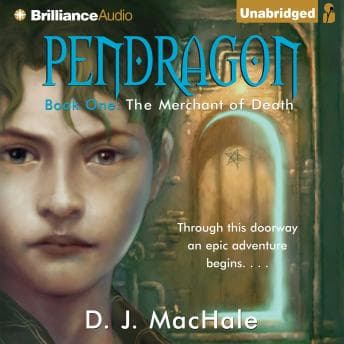

Okay, so here's my complaint: why did nobody tell me about Pendragon when I was fourteen? I was out here reading whatever random fantasy the library had while D.J. MacHale was crafting this dimension-hopping adventure series that would've absolutely consumed my entire middle school existence. I'm genuinely a little bitter about this. My D&D group would have gone feral for this stuff.
I picked this up because I've been on a kick of revisiting (or in this case, discovering) the YA fantasy that shaped a generation of readers. Sea of Monsters was another one of those formative series I somehow missed—caught up with it last month and immediately understood why everyone was obsessed. Listened to most of it during a marathon coding session where I was definitely not working on my thesis. Dr. Patel doesn't need to know.
The Portal Fantasy We Deserved
Look, the premise is pretty straightforward—regular kid gets pulled into interdimensional adventure, has to become a savior, stakes are cosmic. You've seen this before. Percy Jackson does the same chosen-one setup, and honestly Sea of Monsters leans even harder into the formula. But MacHale does something clever with the format that I wasn't expecting: Bobby writes these journal entries to his friends back home, which gives the whole thing this breathless, confessional quality. Like he's debriefing after each insane thing that happens to him.
Denduron as a first territory is solid world-building. You've got your medieval-ish setting with a magical tyrant, a brewing revolution, and these strange beings called Bedoowan and Milago. It's not Sanderson-level magic system complexity (what is?), but for middle grade? The progression is satisfying. MacHale clearly has a larger plan for how these territories connect, and I'm already curious about where it goes.
The pacing is genuinely fast. Like, this thing *moves*. Twelve hours flew by, which—if you know anything about my attention span during thesis season—is saying something.
William Dufris Gets Bobby
Here's the thing about narrating a fourteen-year-old protagonist: you can either make him sound like a tiny adult (boring) or you can actually capture that specific energy of a teenager who's scared and excited and way out of his depth. Dufris goes for the second option, and he nails it.
His Bobby has this youthful urgency that works perfectly for the journal format. When Bobby's panicking, you feel it. When he's marveling at some new weird thing on Denduron, there's genuine wonder there. The voice work for different characters is clear enough that you always know who's talking, which—basic requirement, but you'd be surprised how many narrators fumble it.
Now. I have to be honest. There's this slight... whine? to Dufris's delivery that I noticed early on. It's subtle, but it's there. Took me maybe two hours to stop noticing it, and by the midpoint I was fully adjusted. Some listeners apparently never get past it, and I get that. But for me, once I settled into the rhythm, it stopped being a thing.
Production is clean. No weird audio artifacts, no background noise, nothing technical to complain about.
Roll for Initiative (Or Don't)
If you've got a kid (or a nephew, or a younger cousin, or honestly just yourself) who's looking for a gateway into fantasy adventure, this is a great entry point. It's accessible without being dumbed down. The stakes feel real even when the world is clearly fantastical. Commuters, this is perfect road trip material—the pacing keeps you engaged through traffic, and the chapters break up nicely. I listened during a three-hour drive to visit my mom (who asked about my thesis, I lied about my progress, the usual) and it made the time disappear.
Skip this one if you're a purist about narration and can't handle anything that reads as slightly juvenile in tone. Dufris's style is intentionally youthful, which fits the material but might grate if you're coming straight from, like, Steven Pacey doing grimdark. Sample first.
Campaign Notes: Would I Keep Going?
Yeah. Yeah, I think I would. This is clearly setup for a larger series, and MacHale earned my trust with how he handled this first territory. The ending sets up bigger questions about Bobby's role and what's actually happening with these dimensions, and I'm curious enough to find out.
Is it the most sophisticated fantasy I've ever consumed? No. But it's fun, it's well-paced, and it scratches that portal fantasy itch in a way that feels earnest rather than derivative. Plus, at twelve hours, it's not asking for a massive time commitment before you know if you're hooked.
My D&D group would love this. I'm already thinking about how to steal some of these interdimensional concepts for our next campaign. (Sorry, Bobby. Your adventures are now encounter fodder.)