
Asimov wrote detective fiction disguised as science fiction, and The Robots of Dawn might be his most honest admission of that fact.
I've taught Asimov in my elective unit on speculative fiction exactly twice. Both times, the kids who actually did the reading came back confused — not by the robots or the future politics, but by how much of the book is just two people talking in rooms. "Mr. Williams, when does something happen?" Fair question. My answer then and now: everything is happening. You're just not trained to hear it yet.
The Longest Interrogation You'll Actually Enjoy
Here's what Asimov does in this book that I think gets undersold: he builds an entire murder mystery — well, roboticide mystery — where the primary suspect is someone Baley has to prove innocent. That inversion changes everything about how the detective story works. Instead of hunting for guilt, Baley is hunting for alternative possibilities, and the whole thing becomes this fascinating exercise in logic where every conversation is a chess match. The mystery itself involves Dr. Fastolfe, the one man brilliant enough to have destroyed the humaniform robot Jander Panell, and the political question of who controls Earth's future in the stars. Baley doesn't get to just solve a crime. He has to solve a crime in a way that saves his entire planet's colonial ambitions.
And yes, there's the robot-human romantic relationship between Gladia and Jander that forms the emotional spine of the case. Asimov wrote this in 1983 and was already asking questions about intimacy, consciousness, and what constitutes a "real" relationship that we're still fumbling with in the age of AI. My students would hate this. I love it. The prose deserves to be savored — not because it's lyrical (Asimov was never lyrical) but because every sentence is doing logical work. Miss a clause and you miss the argument.
At nearly sixteen hours, this is a commitment. Asimov doesn't rush. Baley walks through Aurora's open-air landscapes — terrifying for a man raised in enclosed cities — and the book makes you feel every exposed nerve. The pacing is slow by modern thriller standards, but I'd push back on calling it tedious. It's deliberate. This reminds me of what Hemingway said about the iceberg theory — except Asimov puts the whole iceberg on the page and dares you to find what's hidden underneath all that visible logic.
Dufris Understands That Pause Is Punctuation
William Dufris. Let me talk about this man. He's won north of twenty AudioFile Earphones Awards and an Audie, and when I tell you he earns those credentials across sixteen hours of predominantly dialogue-driven science fiction, I mean it. The trap with Asimov audiobooks is that a lesser narrator turns the Socratic exchanges into monotone lectures. Dufris gives Baley a kind of worn, stubborn warmth — you hear a man who's tired and scared and too smart to quit. R. Daneel Olivaw gets this measured precision that's almost human, which is exactly the point. The distinction between them carries the whole partnership.
There are moments of genuine tenderness in this performance, particularly around Gladia's grief for Jander. Dufris doesn't oversell it. He lets Asimov's clinical prose do the heavy lifting and then just... leans into the silences. I was listening during a late Friday grading session — sophomore essays on Lord of the Flies, god help me — and I actually stopped marking papers during one of Gladia's confessions. That doesn't happen often. (The essays were bad. The audiobook was better company.)
I will say: if you've listened to the earlier Robot novels with other narrators, Dufris's interpretations might take an adjustment period. His Spacer characters carry a slight aristocratic remove that works brilliantly for the cultural divide between Earthpeople and Aurorans, but it's a specific choice. I think it's the right one.
Where This Sits in the Asimov Universe
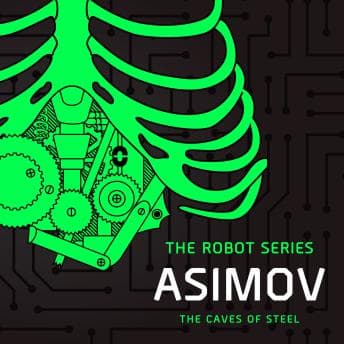
If you loved The Caves of Steel, this is its spiritual successor — but grown up, more politically complex, more willing to sit with uncomfortable questions about what humanity owes its creations. It's also the bridge book between the Robot series and the Foundation series, which means Asimov is laying groundwork here that pays off across thousands of pages of future history. You can read it standalone, but you'd be missing the architecture. I've been thinking lately about how rare it is to find a book that rewards that kind of series investment — Firekeeper's Daughter pulled off something similar for me, where the standalone story is solid but the deeper cultural and political architecture underneath is what makes it linger.
Compared to other Asimov audio productions, Dufris's version holds up as one of the strongest. The man can do sixteen hours without grating on you, which — as someone who has listened to narrators turn into sandpaper by hour six — is not a small thing.
Worth Pausing the Faculty Meeting For
This is for the patient listener. The one who wants their science fiction to ask questions instead of just exploding things. If you need action every chapter, you'll struggle. But if you want to spend sixteen hours inside the mind of a brilliant, anxious detective arguing with robots and politicians about the future of the human race — at 1.0x speed, the way the words were meant to land — this is why we still read the classics. Even when nobody's technically reading.