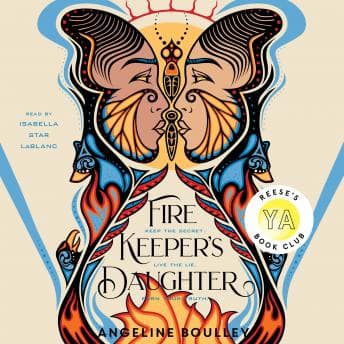

Look, I'll be honest. When I saw this was a YA thriller, I almost passed. Twenty years of teaching high schoolers has made me... cautious about books marketed to them. But then I read that Angeline Boulley is Ojibwe, that the narrator Isabella Star LaBlanc is Sisseton Wahpeton Dakota, and that this thing won a Printz, a Morris, AND an Edgar? Okay. Fine. You have my attention.
I'm glad I listened. Really, really glad.
The Voice That Carries Everything
Isabella Star LaBlanc doesn't just read this book—she inhabits it. And I don't say that lightly. (My students know I'm stingy with praise. They'd be shocked.) Her voice is young and earnest without ever tipping into that performative "teen voice" thing some narrators do. You know what I mean—that slightly breathless, overly enthusiastic delivery that makes you feel like you're being sold something.
No. LaBlanc sounds like Daunis. Like she's lived in that space between two worlds, never quite fitting into either. The Ojibwe phrases and Anishinaabe traditions flow from her with the kind of ease that only comes from genuine familiarity. This isn't someone who practiced pronunciation guides for a few weeks. This is someone who understands the weight of those words.
The supporting cast gets distinct treatment too. The tribal elders sound like elders—there's a gravity there, a patience in the pacing. Jamie sounds like exactly the kind of charming hockey player who'd make an eighteen-year-old's heart do stupid things. (Don't tell my students I said that either.)
When the Story Grabs You By the Throat
Here's the thing about Firekeeper's Daughter: it's doing a lot. Coming-of-age story. Murder mystery. FBI investigation. Drug trafficking thriller. Cultural reclamation narrative. Identity exploration. In lesser hands, this would be a mess. Boulley somehow makes it work.
Daunis is the kind of protagonist I wish more of my students could encounter. She's smart—like, actually smart, not just "the narrative tells us she's smart." Her chemistry knowledge matters. Her understanding of traditional medicine matters. Her position as someone who exists between the reservation and her hometown matters. Everything about her identity becomes relevant to the plot.
I listened to most of this while grading papers at 11 PM (the irony of grading essays about The Great Gatsby while listening to a book about a young woman navigating her fractured identity is not lost on me). There were moments I had to stop grading entirely. The murder scene. The slow unraveling of who Jamie really is. The moments when Daunis has to choose between protecting herself and protecting her community.
LaBlanc handles all of it—the joy, the anger, the fear, the grief—with a sensitivity that never feels manipulative. When Daunis is scared, you feel it in your chest. When she's furious, you understand why.
The One Thing That Bugged Me
Okay, so. The audio quality. Some listeners have complained about an echo, like the recording was done in a big empty room. I noticed it in a few spots—nothing that ruined the experience, but enough to pull me out of the story momentarily. It's frustrating because LaBlanc's performance deserves pristine production. She earned it.
If you're really sensitive to audio quality issues, maybe sample first. For me, the narration was strong enough to carry through the technical hiccups.
Who Should Listen (And Who Should Skip)
This book is going to hit different depending on who you are. If you're a fan of Angie Thomas or Tommy Orange—yeah, the comparisons are earned. That same intensity—stories that refuse to look away—shows up in Red Rising, though Pierce Brown takes it to a completely different world. If you're interested in Indigenous culture and identity but haven't found your entry point, this is it. If you want a thriller that actually has something to say about justice, community, and what it means to protect the people you love even when the system doesn't care about them? This is your book.
Who should skip? Anyone not ready for heavy content. There's violence here. Drug use. Sexual assault. Suicide. Boulley doesn't shy away from the hard stuff, and LaBlanc doesn't soften it in the delivery. My students would need preparation before reading this. (Some of them would also need tissues. I'm not saying I needed tissues. I'm just saying the lakefront was very windy that day.)
Would I Assign This?
If I taught a contemporary lit class instead of the classics? Absolutely. This is why we still read—to understand experiences different from our own, to see the world through someone else's eyes. Daunis's story isn't universal, and it shouldn't be. It's specific and rooted and deeply Anishinaabe. That specificity is what makes it powerful.
The prose deserves to be savored. LaBlanc understands that. She gives the words room to breathe, lets the pauses do their work. I listened at 1.0x, obviously, because I'm ancient and the author chose those words.
Fourteen hours well spent. Worth pausing the faculty meeting for. (Sorry, Principal Martinez.)









