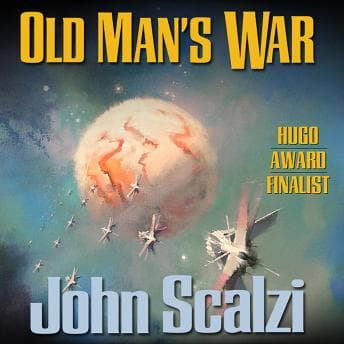
Look, I have a bone to pick with John Scalzi. You don't get to write a trilogy conclusion where the protagonist goes from quiet farmer-ombudsman to pawn in an interstellar chess game and then wrap it all up in under 10 hours. That's like refactoring a monolith into microservices over a long weekend — technically possible, but someone's cutting corners.
And yet. AND YET. I finished this in two commutes and immediately wanted to re-listen to the whole Old Man's War trilogy from the start. So clearly something's working here.
The Compressed Deploy That Somehow Doesn't Break Prod
Here's the thing about The Last Colony that hit me around hour 3, somewhere between Millbrae and San Mateo while a guy next to me was eating what I can only describe as a revenge burrito: this book is doing A LOT. John Perry and Jane Sagan get recruited to lead a brand-new colony called Roanoke (yes, the naming is deliberately ominous). But it's not really a colony story — it's a political thriller wrapped in a survival narrative wrapped in a "the entire galaxy wants you dead" situation. The Colonial Union has been playing Perry like a pawn from page one, and the reveal of exactly how deep the manipulation goes genuinely surprised me.
The pacing complaints I've seen are valid, honestly. There's a stretch in the middle where we whip from colony governance to alien fleet threats to Conclave politics so fast it feels like three different books got shoved through a merge conflict. Scalzi's doing that thing where he trusts the reader to keep up, which I appreciate, but at 1.5x speed on the morning train, I had to rewind twice during the section where Perry figures out the Colonial Union's real plan for Roanoke. The plot machinery is clever — genuinely clever — but it's dense.
But then Jane Sagan goes on her solo mission to secure the colony's survival, and everything snaps into focus. That sequence is probably the best stretch of writing in the entire trilogy. She's operating with almost no resources, making tactical decisions that would make any incident commander proud, and you feel the weight of every choice. It's the kind of section where I missed my stop. Actually missed my stop. Had to sheepishly Caltrain back one station.
William Dufris Is Not Ray Porter (But He's Earned His Keep)
Okay, I'll say it — I spent the first hour of Old Man's War wishing Ray Porter was narrating. (Ray Porter narrates everything I love. This is a known bias. I'm working on it.) But by book three, Dufris has fully earned the chair. His Perry is this perfect blend of dry wit and exhaustion — the voice of a guy who's seen too much and handles it with sarcasm because the alternative is screaming. His Jane Sagan reads as controlled and deliberate, almost clipped, which works for a former Special Forces supersoldier who processes emotions like a background thread.
What I appreciate most is the consistency across three books. Same vocal signatures, same character energy. That matters when you're binging a trilogy over a few weeks. No jarring resets. He's not a flashy narrator — no wild accents or dramatic pauses that make you look up on the train — but he's reliable in the way a well-maintained codebase is reliable. You trust it. You stop thinking about it. You just follow the story.
The Science (Mostly) Holds Up, The Politics Definitely Do
Scalzi's always been more interested in the political architecture of his universe than the hard physics, and The Last Colony goes full political thriller. The Conclave — this massive alien coalition trying to stop unilateral colonization — is genuinely interesting as a political concept. To Sleep in a Sea of Stars goes similarly deep on the political machinery of interstellar factions, though it takes about four times as long to get there — which on a two-hour daily commute is either a feature or a bug. It's basically the UN but with teeth and actual enforcement mechanisms, and the way Scalzi uses Roanoke as a pressure point between the Conclave and the Colonial Union feels uncomfortably relevant to anyone who's watched real geopolitical proxy games play out.
The final plan Perry cooks up to protect the colony is — okay, I won't spoil it, but it made me grin on the train like an unhinged person. It's the kind of solution that only works because Scalzi spent two and a half books establishing how this universe's politics function. Satisfying in the way a well-designed system is satisfying: all the components suddenly clicking.
Who Gets a Seat on This Train
If you've read Old Man's War and The Ghost Brigades, this is a no-brainer — finish the trilogy. If you haven't started the series, do NOT start here; you'll be lost in about fifteen minutes. Skip if you want hard sci-fi or if compressed pacing makes you twitchy.
Perfect for: train, gym. Skip for: deep work — the political threads demand at least 60% of your brain.
TL;DR: Worth Your Commute (With One Caveat)
It's the shortest book in the trilogy and tries to do the most, which means it occasionally feels like a sprint through a plot that deserved a marathon. But Perry's voice, Sagan's badassery, and that final act payoff make it land. The ROI on this audiobook is high — under 10 hours for a satisfying trilogy conclusion with real political teeth. I finished it wanting more, which is either perfect or a flaw depending on your perspective. (Kevin says it means I should finally read Zoe's Tale. Kevin might be right again. Don't tell him.)