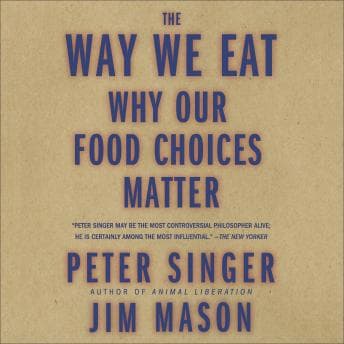

Everyone told me this book would make me go vegan. Spoiler: it didn't. But it did something arguably more interesting — it made me examine the psychology behind why I resist changing my food choices even when the evidence is staring me in the face. And honestly? That's the kind of uncomfortable self-examination I live for.
I was elbow-deep in making my mother's rajma recipe — kidney beans simmering in a masala that takes forty minutes of patience I barely have — when I started this audiobook. There's something almost perverse about listening to an exhaustive ethical analysis of food production while you're actively cooking. Every time Singer and Mason described the supply chain behind a particular ingredient, I found myself glancing at the items on my counter like they were suspects in a lineup.
Peter Singer Did Not Come Here to Make You Comfortable
Here's what I expected: a polemic. Singer is THE animal rights philosopher. Animal Liberation basically invented the modern animal ethics conversation. So I was bracing for twelve and a half hours of guilt-tripping. What I got instead was something more structured and, frankly, more psychologically fascinating. Singer and Mason follow three American families with different eating habits — a conventional family who shops at Walmart, a conscientious omnivore family, and a vegan family — and then trace the actual supply chains behind their food choices. It's less "you're a monster for eating chicken" and more "here's precisely what happened to that chicken before it reached your plate, now you decide."
The protagonist exhibits classic moral reasoning patterns — and by protagonist, I mean the reader. That's the trick. Singer, being the utilitarian philosopher he is, isn't really writing about food. He's writing about how humans justify their choices. The sections on factory farming are genuinely hard to listen to (content warning: they describe conditions in industrial animal agriculture with clinical precision, and clinical precision somehow makes it worse). But what made me pause my jog more than once — yes, I eventually moved this to my morning runs through Cambridge because it pairs well with the kind of focused discomfort that physical exertion brings — were the chapters on "compassionate" or "ethical" meat. The way Singer dismantles the feel-good marketing of "cage-free" and "free-range" labels is a fascinating case study in how we use language to manage cognitive dissonance.
I found myself asking: why does the conscientious omnivore family interest Singer more than the vegan family? And I think the answer is that they represent the majority of his audience. People who care enough to think about ethics but not enough to fully change behavior. The research actually shows this is where most humans operate — in the messy middle of wanting to be good but not wanting it to cost too much.
Rick Adamson and the Art of Not Editorializing
Rick Adamson's narration is... interesting in its restraint. Compare this to, say, any audiobook where the narrator practically tells you how to feel with vocal inflection alone. Adamson reads descriptions of industrial slaughterhouses and organic farm operations with the same measured, almost documentary tone. No dramatic pauses when the content gets grim. No warmth injected when describing the vegan family's choices. It's the audiobook equivalent of a researcher presenting data without interpreting it for you.
Does it work? Mostly yes. The objectivity actually amplifies the horror of certain passages because your brain has to do all the emotional processing without any vocal cues to guide you. But at twelve and a half hours, that same flatness can feel relentless. Around hour seven — the sections on seafood and the environmental impact of fish farming — I caught my attention drifting. Not because the content wasn't important, but because Adamson's delivery doesn't modulate enough to signal "this next part matters more." Everything gets the same weight, which is philosophically appropriate but audiobook-functionally challenging.
The Part Where I Get Annoyed (Because I Always Do)
The book is from 2006, and it shows. Some of the corporate practices described have shifted (though whether they've genuinely improved or just improved their PR is another question Singer would probably enjoy dissecting). The data on environmental impact, while directionally correct, feels dated when you compare it to more recent work. If you're coming to this after reading anything from the last five years on food systems, you'll notice the gaps.
Also — and this is the psychologist in me — Singer and Mason are better at analyzing systems than individual motivation. They can tell you exactly what's wrong with factory farming. They're less equipped to tell you why knowing all of this still doesn't make most people change. That's the missing chapter. The psychology of why people resist changing behavior even when confronted with evidence is honestly its own field — one I went deep on while reading For Women Only, which does a much more granular job of excavating the gap between what people know about themselves and what they actually do. My therapist would have thoughts about the fact that I noticed this absence more than the content itself.
Who Should Listen (And Who's Going to Hate It)
If you've never seriously thought about where your food comes from, this will rearrange some furniture in your brain. If you're already well-versed in food ethics, it might feel like a review session — thorough but not revelatory. And if you're looking for a prescriptive "eat this, not that" guide, psychologically, this doesn't track as that kind of book. It's philosophy with case studies, not a diet plan.
My Clinical Assessment
This is a book that respects its audience enough to present evidence and let you sit with the discomfort. It won't bully you into veganism, but it will make every trip to the grocery store feel like an ethical pop quiz for a while. I finished it three days ago and I'm still thinking about the egg industry chapter while staring at my carton of eggs. Which, I suppose, is exactly what Singer wanted.