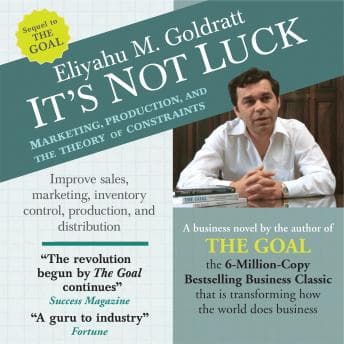

"It's not luck. It's logic." Somewhere around the two-hour mark, Alex Rogo drops this line while trying to save three failing divisions from being sold off, and I had to pause mid-rep at the gym because — yeah. That's basically the thesis of every engagement I've ever run, distilled into five words.
Bottom line: This is the rare business sequel that actually earns its existence. If The Goal taught you about bottlenecks in manufacturing, It's Not Luck takes Theory of Constraints and drags it into the messy, political, deeply human world of marketing, sales, and — surprisingly — marriage counseling. At 8 and a half hours, it's padded in places, but the core ideas hit harder than most standalone business books.
My Parents Ran Three Constraint Systems Simultaneously (They Called It Tuesday)
Here's what Goldratt does that most business authors can't: he makes you feel the constraint before he names it. Rogo's three division managers are each drowning in their own version of the same problem — they're optimizing locally instead of thinking about the whole system. One division is discounting to move inventory. Another is chasing revenue that destroys margins. The third is so focused on cost-cutting they're killing the product.
I've seen this fail at three different companies. Actually, more like twelve. The Thinking Processes Goldratt introduces here — the evaporating cloud, the current reality tree, the future reality tree — sound academic until you realize they're just structured ways of doing what smart operators already do intuitively. This is what my parents did instinctively. Now it has a TED talk. My dad never drew a current reality tree, but when he decided to stop competing on price with the new dry cleaner across Western Ave and instead offer same-day service for wedding season, he was doing exactly what Goldratt describes: identifying the core conflict, challenging the assumptions underneath it, and finding a solution that doesn't require compromise.
The difference is Goldratt gives you a repeatable framework. My dad had instinct. Instinct doesn't scale. Frameworks do.
The Business Novel Format Is Either Genius or Torture (This One's Closer to Genius)
Let's talk about the format. Business fiction is a genre that usually makes me want to throw my phone into traffic. Design Thinking Handbook falls into that trap more than once — good ideas wrapped in dialogue so stagey it pulls you right out of the lesson. Most of it reads like a PowerPoint deck wearing a cheap disguise — "And then the VP of Operations said, 'You know, Jennifer, what we really need is a value stream map.'" Insufferable.
Goldratt mostly avoids this. Mostly. The personal storylines — Rogo's marriage stress, his daughter's school problems — feel grafted on at times, but they serve a purpose. He uses the evaporating cloud technique on a family conflict, which is either brilliant pedagogy or the most McKinsey thing I've ever encountered. (Jenny would appreciate the marriage subplot. I appreciated that it demonstrated the framework applies outside boardrooms. We'll call that a draw.)
Rick Adamson's narration is workmanlike and clear. He doesn't do wildly differentiated character voices — you're not going to confuse this with a full-cast production — but his pacing is steady and he handles the technical sections without making them sound like an instruction manual. For a book where characters literally walk through logic trees out loud, that's no small feat. Solid 3.5 narrator who knows his lane and stays in it.
At 2.0x speed, I got through this in about four and a quarter hours, which felt right. Some of the middle chapters where Rogo is shuttling between divisions get repetitive — we get it, each manager has their own version of the same epiphany. Skip to chapter 5. Thank me later. That's where the actual Thinking Processes framework kicks in and the book stops warming up.
Who Gets ROI From This
If you've read The Goal: this is your next listen, no question. It takes the manufacturing-focused TOC and proves it works for strategy and marketing decisions. If you haven't read The Goal: start there first. This book assumes you know what a bottleneck is and why Herbie matters.
Operations people will love it. Marketing folks might bristle at how Goldratt simplifies their world, but the logic is sound even when the scenarios are stylized. Founders running multiple product lines or trying to figure out which business unit to kill? This is basically a case study disguised as a novel.
People looking for a quick productivity hack or a listicle of tips — this isn't for you. Goldratt makes you work for the insight. The payoff is worth it, but you have to sit through the setup.
The Consulting Engagement I'd Actually Recommend
The key takeaway is worth the listen. The other 7 hours? Not so much — but that middle 60% is still better than 90% of the business books clogging my Audible library. Goldratt respected operators. You can feel it in how he writes about the division managers — they're not idiots who need a guru to save them. They're smart people trapped in bad assumptions. That distinction matters. My parents weren't lacking intelligence. They were lacking a framework to see what they already knew. Dare to Lead makes a similar point about leaders who already have the instincts but need a vocabulary to act on them — though Brown is working in feelings where Goldratt is working in logic trees.
Jenny would say I'm being harsh giving this a 3.5 instead of a 4. Jenny is right. But I've got 200 unfinished audiobooks and a standard to maintain.