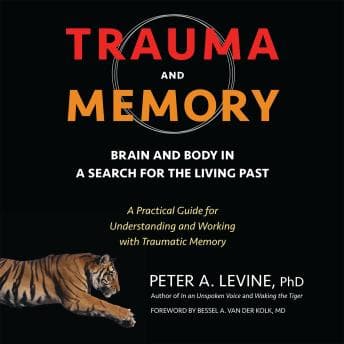

Look, I'm going to be upfront about something that's been bugging me for years: the self-help industrial complex has a trauma problem. Everyone wants to write about trauma now. It's the new productivity hack, apparently. But Peter Levine? He's been in this space for 45 years, long before it was trendy, and it shows.
Here's the thing - I picked this up because half my startup clients are burned out founders who need therapy more than they need another pivot strategy. (Jenny says I'm not qualified to make that assessment. Jenny is right.) But understanding how trauma actually works in the body? That's useful information when you're trying to figure out why a CEO freezes up every time they have to fire someone.
The ROI on Dense Academic Content
Bottom line: this is a 5.5-hour investment that delivers maybe 3 hours of genuinely actionable insight. Which, for a business book, would be terrible. For an academic psychology text? That's actually pretty good.
Levine's core argument is simple but counterintuitive - the memories we can consciously recall aren't necessarily the ones driving our behavior. It's the body's implicit memory, the stuff we don't even know we're carrying, that's running the show. This is what my parents did instinctively when they pushed through 14-hour days at the dry cleaners. They didn't process trauma through talking. They moved. They worked. They kept their hands busy. Now it has a TED talk.
The case studies are where this book earns its keep. Real patients, real breakthroughs, real explanations of what was happening neurologically. Some listeners have complained that Levine recycles case study names across his books - fair criticism if you've read everything he's written, but for a first-time listener, they work.
The Moviefone Problem
Okay, so about Rick Adamson's narration. Someone in the reviews called him "the Moviefone guy" and I cannot unhear it. There's this slightly dramatic edge to his delivery that occasionally makes case studies about childhood trauma sound like movie trailers. "In a world where memory lives in the body..." You know the vibe.
But here's my defense of Adamson - the material is dense. Really dense. Jargon-heavy, scientific, the kind of content that would put you to sleep on a long commute if delivered in a monotone. His dynamic reading actually keeps you engaged through the technical sections. Is it occasionally ominous when it shouldn't be? Sure. Would I take that over boring? Every time.
I listened at 1.25x instead of my usual 2.0x, and even then I had to rewind a few sections. This isn't a failure of the audiobook - it's just the nature of the content. You're essentially getting a graduate-level seminar on somatic experiencing. Treat it accordingly.
Who This Is (and Isn't) For
If you're a therapist, counselor, or anyone working in mental health - this is worth your time. Period. The framework Levine provides for understanding how trauma gets stored and accessed is practical enough to apply immediately.
If you're a regular person trying to understand your own trauma - proceed with caution. This isn't "The Body Keeps the Score lite." It's academic. It's clinical. It assumes you have some baseline knowledge of psychology. I've seen this approach fail with clients who wanted quick fixes. This isn't that. Skip it if you need something more accessible.
And if you're like me - a consultant who keeps bumping into trauma responses in professional settings - it's genuinely useful context. Understanding why someone's nervous system is hijacking their decision-making is step one to helping them work through it. (Or at least knowing when to refer them to an actual professional.)
The Bessel van der Kolk Endorsement
The foreword is by Bessel van der Kolk, which in trauma circles is basically a Michelin star. It's short but it sets up Levine's contribution to the field nicely. If you've read "The Body Keeps the Score," this is a logical next step - more specialized, more focused on the memory piece specifically.
Park's Prescription
My 2.0x speed couldn't save this one, but that's not a criticism. Some books deserve slower consumption. At 5.5 hours, it respects your time more than most academic texts. Though if you need a palate cleanser after all this clinical density, Just After Sunset: Stories offers a different kind of psychological exploration—King's brand of horror that gets under your skin without the academic framework. The jargon-heavy tangents? Skip forward 30 seconds. Thank me later.
Content warning that matters: there are discussions of sexual abuse and detailed case studies that could be triggering. This isn't theoretical - it's clinical. Plan your listening environment accordingly. I wouldn't recommend this on a crowded subway where you can't pause and breathe.