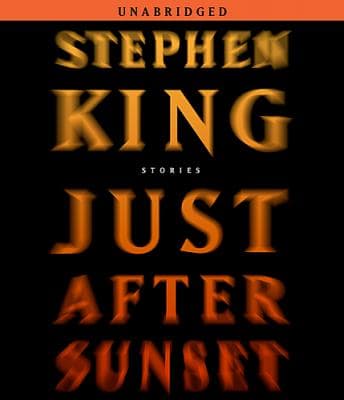

Stephen King short story collections are basically case studies in what happens when you let a master of human psychology loose on thirteen different premises. And honestly? Just After Sunset is exactly that - a psychological playground where King gets to dissect grief, obsession, guilt, and the particular flavor of dread that creeps in right when the sun goes down.
I listened to most of this during my morning runs through Cambridge, which - in retrospect - was maybe not the best choice for stories about stationary bikes that trap you in existential horror. The irony wasn't lost on me.
The Ensemble Cast Experiment
Here's what makes this audiobook fascinating from a research perspective: you've got ten different narrators interpreting King's voice. Ten. That's basically a controlled study in how performance shapes narrative perception. George Guidall brings his signature warmth to some pieces. Denis O'Hare - and I cannot stress this enough - absolutely destroys the story "N." in the best possible way. His performance of a man unraveling into obsessive-compulsive terror is the kind of character work I wish I could assign to my students as an example of psychological authenticity.
And then there's King himself narrating. Which is... an experience. The man writes like he talks, so hearing him actually talk his own words creates this weird meta-layer that I found genuinely compelling. Not everyone will love it. Some people want their authors invisible. But if you're interested in authorial intent made audible? It's kind of perfect.
The production quality is clean throughout. No weird audio jumps between narrators, which - given how many voices are involved - is actually impressive.
Where the Psychology Gets Interesting
Look, I'm going to be honest: not every story here is a home run. Some of them drag. "The Gingerbread Girl" takes its time in ways that felt deliberate but also... long. "A Very Tight Place" is exactly as claustrophobic as the title suggests, which is either a feature or a bug depending on your tolerance for extended descriptions of being trapped in a portable toilet. (Yes, really.)
But the stories that work? They work because King understands something fundamental about how humans process trauma and fear. "The Things They Left Behind" is a devastating meditation on survivor's guilt post-9/11. The protagonist exhibits classic avoidance behaviors that gradually shift into something more ritualistic, more magical-thinking. It's psychologically accurate in ways that made me uncomfortable - which is exactly the point. That same psychological precision shows up in House of a Thousand Candles, where the tension builds through character observation rather than action.
"Harvey's Dream" is maybe four thousand words of pure dread. A wife listening to her husband describe a nightmare at the breakfast table. That's it. That's the whole premise. And yet King builds this architecture of marital tension and unspoken resentment that made me genuinely anxious. My therapist would have thoughts about why I found it so affecting. I'm choosing not to examine that too closely.
"N." remains the standout. It's essentially a case study in obsessive-compulsive disorder wrapped in cosmic horror, and the research actually shows that King's portrayal of intrusive thoughts and compulsive rituals is remarkably accurate. The character's descent into counting, checking, and ritualistic behavior isn't played for cheap scares - it's treated with the kind of specificity that suggests King either did his homework or has personal experience with anxiety disorders. (Probably both, given his other work.)
The Uneven Terrain
Here's where I have to be real: if you're coming to this expecting constant terror, you're going to be disappointed. This isn't It or The Shining. These are quieter stories. Some of them are barely horror at all - they're more like character studies that happen to involve supernatural elements.
"Ayana" is about faith and healing and reads almost like literary fiction. "Mute" is a revenge story that's more Hitchcock than horror. "Graduation Afternoon" is genuinely beautiful and sad in ways that have nothing to do with monsters.
Some listeners find this frustrating. I found it fascinating - watching King move between registers, testing what his voice can do when it's not trying to scare you. But I'm also the person who reads fiction like case files, so. Your mileage may vary.
The pacing across the collection is uneven. A few stories overstay their welcome by about fifteen minutes. If you're the type who needs constant momentum, this might test your patience. I'd recommend the 1.25x speed for the slower pieces - it tightens things up without losing the atmospheric work the narrators are doing.
Who Should Listen (And Who Should Skip)
This is for King fans who want to see him working in miniature. For people who appreciate psychological complexity over jump scares. For anyone who's ever wondered what it feels like to be trapped in your own obsessive thoughts - "N." will give you a visceral understanding.
Skip it if you want pure horror. Skip it if you're impatient with character development. Skip it if you need every story to deliver the same emotional payload.
But if you're interested in how a master storyteller dissects the human mind across thirteen different scenarios? This is a genuinely rewarding listen. Uneven, yes. Sometimes tedious, sure. But the high points - the moments when King's understanding of fear and guilt and obsession clicks into place - those are worth the slower stretches.
I finished the last story on a Tuesday morning, somewhere near the Charles River, and spent the rest of my run thinking about why we need rituals to feel safe. Which is probably exactly what King intended.