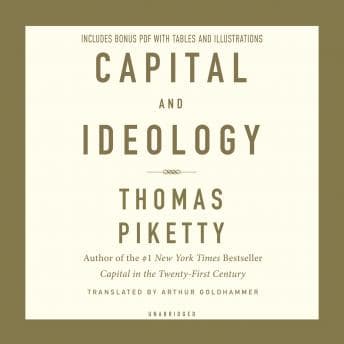

Forty-nine hours. Let that sink in. That's two full days of your life. A cross-country road trip with no bathroom breaks. Longer than most audiobooks I've listened to combined in a month.
I finished it anyway. At 2.0x speed. Jenny thinks I've lost my mind.
The Piketty Problem (And Why I Kept Listening)
Here's the thing about Piketty that drives me crazy—and also why I respect him. He doesn't give you the executive summary version. Capital in the Twenty-First Century was already a beast, but this sequel? It's like he looked at that book and said "you know what, let's go deeper." A thousand years of inequality, from medieval trifunctional societies to modern hypercapitalism, with stops at every colonial atrocity and ideological dead-end along the way.
My parents ran a dry cleaning business for 30 years. They never read economic theory. But everything Piketty describes—the way property rights get constructed to benefit those who already have property, the way "natural" economic laws are really just choices we've made—they lived that. They watched landlords raise rent because they could, watched bigger chains squeeze out small businesses because the rules were written that way. Piketty puts academic language to what immigrants figure out in their first year: the game is rigged, and the rigging has a history.
Rick Adamson Deserves Hazard Pay
I need to talk about the narrator, because Rick Adamson is doing something genuinely heroic here. Nearly 49 hours of dense economic history, statistical analysis, and political philosophy—and he makes it... listenable? His pace is steady without being monotonous, which is harder than it sounds when you're reading passages about Swedish inheritance tax policy in the 1970s.
The guy won an Audie Award, and after this performance, I understand why. There's no dramatic range because there's no drama to perform—this is a treatise, not a thriller. But Adamson provides what the material actually needs: clarity and consistency. When Piketty goes on a 45-minute tangent about Brazilian electoral coalitions, Adamson doesn't lose you. That's a skill.
Fair warning though: you will miss the charts. Piketty loves his data visualizations, and audio format means you're taking his word for what the graphs show. For casual understanding? Fine. For actually engaging with his arguments at a technical level? You might want the print edition nearby.
The Core Thesis Is Worth the Listen. The Other 47 Hours? Debatable.
Bottom line: Piketty's central thesis is powerful and, I think, correct. Inequality isn't natural—it's ideological. Every society tells itself stories about why some people deserve more than others, and those stories change based on who's doing the telling. I saw a different angle on these justification mechanisms in Give and Take, where Adam Grant explores how we rationalize who deserves success in corporate America—same pattern, different century. Slavery had its ideology. Colonialism had its ideology. Modern billionaire worship has its ideology. Once you see the pattern, you can't unsee it.
But does it need to be 49 hours? Look, I've sat through McKinsey presentations that could've been emails. This book could've been... less. Piketty's thoroughness is both his strength and his weakness. Yes, I appreciate the global scope—he doesn't just do Europe and America, he covers India, China, Brazil, the Middle East. But some chapters feel like he's proving points already proven three chapters ago.
Skip to the sections on "participatory socialism" if you want the prescriptive stuff. His proposals—progressive wealth taxes, educational equality, worker representation on corporate boards—are actually practical, not pie-in-the-sky. Whether you agree or not, at least he's offering solutions instead of just diagnosing problems.
Who Gets Their Credit's Worth (And Who Should Bail)
This is for the serious listener. The person who treats economics like it matters—because it does. If you're looking for business tips or productivity hacks, you're in the wrong aisle. This is history, politics, and ideology wrapped in economic analysis.
Perfect for: Long commutes over several months. Grad students in economics or political science. Anyone who finished the first Capital book and wanted more. People who've ever wondered why their parents worked so hard and still couldn't get ahead.
Skip if: You need actionable takeaways in under 10 hours. You're looking for background listening. You get frustrated when academics refuse to simplify.
The ROI Calculation
Would I recommend this to a client? Depends on the client. For understanding how inequality actually works—not just the symptoms, but the historical machinery—there's nothing better. Piketty did the research so you don't have to. But this is a commitment. A relationship. Possibly a lifestyle.
I finished it at 3 AM last Tuesday, and Jenny found me staring at the ceiling thinking about Swedish social democracy. She asked if I was okay. I said I was reconsidering everything I thought I knew about property rights.
She went back to sleep. Smart woman.