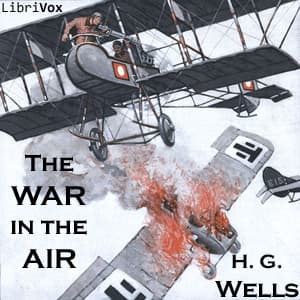

"The world is at war, and Bert Smallways - a bicycle repairman from Bun Hill - is somehow in the middle of it."
I found that premise at about hour two, sitting cross-legged on my apartment floor surrounded by half-unpacked board game expansions I keep telling myself I'll organize. And I just... stopped. Put down the Wingspan bird cards. Because H.G. Wells wrote that sentence in 1908 and it still hits like a truck.
War in the Air is Wells doing what Wells does best - taking an ordinary, slightly dim everyman and dropping him into civilizational collapse. Bert Smallways is not a hero. He's not clever. He accidentally ends up aboard a German airship fleet that proceeds to bomb New York City into rubble, and his main response to all of this is a kind of bewildered, bumbling survival instinct. It's darkly funny in a way that feels almost accidental, like Wells couldn't help himself.
The prophetic stuff is genuinely wild when you sit with it. This was published six years before WWI. Wells describes aerial bombardment of civilian populations, the collapse of global economic systems, the way no single nation can actually "win" a war fought this way - just mutual destruction until civilization itself starts falling apart. He called it. Not perfectly, not in every detail, but the shape of it? Disturbingly accurate. My D&D group would love the geopolitical worldbuilding here - there are German, American, Asian air powers all maneuvering against each other, and Wells sketches out the whole board with this almost casual confidence.
H.G. Wells Predicted the Internet Age (And Also Chaos)
What surprised me most, honestly, was the tone. I expected dry Victorian sci-fi. What I got was something closer to dark satire. Wells is clearly furious - at nationalism, at militarism, at the cheerful human capacity to invent new ways to kill each other faster than we develop wisdom to not use them. Bert wandering through the wreckage of New York, then through the collapse of European civilization, functions almost like a camera panning across a disaster Wells saw coming and couldn't stop. That sense of an ordinary person just trying to survive while the world reshapes itself around them is something Railway Children captures too, though from a much quieter domestic angle — kids watching their stable Edwardian life quietly unravel, one train platform at a time.
The pacing is uneven, I'll be honest. The middle section drags in places where Wells goes full essay-mode, stepping back from Bert's story to editorialize about the state of civilization. If you don't like info-dumps, this isn't for you (but you're wrong - the rants are half the point). The final act, where the world has genuinely fractured into chaos and Bert is just trying to get home, hits harder than I expected. There's a bleakness to it that feels earned.
At 10h 54m, it's not a massive commitment. I finished it across maybe three sessions - the board game floor session, a late night when I should've been writing my thesis (I was not writing my thesis), and a Sunday morning with coffee.
About Those "Various Readers"
Okay, here's where I have to be real with you. The "Various Readers" format is a gamble, and based on what I can tell, this production lands somewhere in the middle. The listener feedback is split - some people felt the narration did justice to Wells, others found it just okay. I'd lean toward "functional but not inspired." Nobody here is Steven Pacey doing Logen Ninefingers. The readers seem competent but not particularly distinct from each other, which is a shame because Bert's voice - that confused, working-class muddle-through energy - really wants a committed character performance.
It doesn't ruin the book. Wells' prose is strong enough to carry the weight. But if you're used to narrators who make you forget you're listening to a recording, this might feel a bit flat in comparison. I'd call it a 1.25x speed situation - the pacing benefits from a slight push.
If You're Deciding Whether to Spend a Credit
Here's who this is for: people who like their sci-fi with actual ideas attached, who don't mind a protagonist who is mostly confused and reactive, and who find "this was written in 1908 and predicted air warfare" genuinely fascinating rather than just trivia. If you're coming for action-movie energy, Bert Smallways is not your guy.
The narration is the weak link. The content is legitimately great - this is Sanderson-level worldbuilding for its era, except Wells built it from scratch with zero genre template to follow. But the audio production doesn't elevate it the way a great narrator would. Stream it, borrow it from your library's Libby app, or catch it on sale. The book deserves your time. The specific audiobook production? Doesn't quite deserve your credit.