
What happens when you take a villain whose backstory you already know and ask the audience to sit with him for eight more hours?
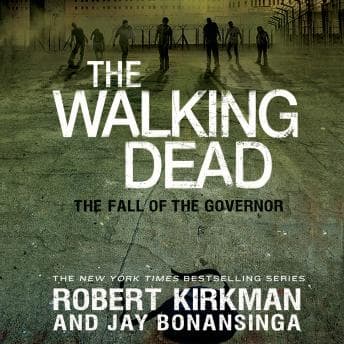
That's the gamble The Fall of the Governor: Part One makes. And honestly? It's a gamble that only half pays off.
I was shelving returns at the library on a Saturday afternoon - the quiet kind of Saturday where nobody comes in and the fluorescent lights hum just loud enough to be creepy - and I had this queued up because I'd burned through Rise of the Governor and The Road to Woodbury back to back. The Governor as a character fascinates me. Not because he's complex in the traditional literary sense, but because Kirkman and Bonansinga are doing something interesting with the banality of cruelty in a world where societal rules have dissolved. Philip Blake isn't a mustache-twirling cartoon. He's a community leader who tortures people in his spare time. That's scarier than any walker.
Fred Berman Understands the Assignment (Mostly)
The narrator commits. That's rare. Berman's been with this series from the start, and you can feel his familiarity with the material - he shifts from the Governor's controlled, almost paternal authority voice to the trembling uncertainty of Lilly Caul without it ever feeling like a performance trick. His reading of Bob Stookey - that broken, tender, alcoholic mess of a man - carries genuine emotional weight. There's a scene where Bob is processing his feelings for someone while simultaneously acknowledging that love in Woodbury is just grief waiting to happen, and Berman's delivery slows just enough to let that land without overselling it.
But here's my gripe. The pacing. Berman reads deliberately, which works beautifully during the Governor-Michonne scenes (electrifying, genuinely uncomfortable, the kind of horror that makes you glance around the empty library like someone might judge you for listening). But during the middle stretch - and there IS a middle stretch - that deliberate pace turns the thin parts thinner. You feel every minute of the padding. I'd have killed for him to pick up the tempo during the Lilly and Austin romance beats, which read like a CW subplot dropped into a George Romero film.
The Split That Didn't Need to Happen
Let's talk about the elephant in the room. This is Part One of a story that was clearly one book carved into two for commercial reasons. You can feel the seams. Around hour five, the story starts circling - repeating character dynamics we've already established, stretching scenes that should've been tight. Lilly's internal monologue about whether the Governor can be trusted cycles through the same territory three or four times, and by the third pass I was mouthing the words before Berman said them.
And then - AND THEN - when Rick, Michonne, and Glenn finally show up and things get genuinely electric, when the collision between the comic storyline and the novel universe starts firing on all cylinders... it ends. Part One. See you next book. I actually said "you're kidding me" out loud in the empty library. Shirley (my cat, not Jackson, though Jackson would also be unimpressed) gave me the same look she gives me when I run out of treats.
The torture scenes deserve a content warning and then some. This isn't horror that builds dread - this is horror that describes, in clinical detail, what happens when a sociopath has unlimited power and no accountability. I'm not squeamish, but there are passages here involving the Governor and Michonne that are gratuitous even by Walking Dead standards. If you scare easily, skip. If you don't, well - you'll still want to brace yourself.
When It Works, Though
When this book stops padding and starts being the story it wants to tell, it's genuinely good zombie fiction. The Governor's psychology - the way he justifies atrocity through a warped paternalism toward Woodbury - is the kind of villain writing that Shirley Jackson walked so Kirkman could run. Not to that level, obviously, but in the same spirit. The horror isn't in the dead walking. It's in the living choosing to follow a monster because the alternative is chaos. That particular brand of dread — the kind rooted in human complicity rather than supernatural menace — is something House on Vesper Sands also excavates, though in a Victorian wrapper that makes the rot feel somehow more suffocating.
Berman's handling of the grisly material is worth noting specifically - he doesn't lean into the gore with relish, but he doesn't shy away either. He reads the violence with a kind of flat, factual delivery that makes it worse. Like a news report from hell. That's a choice, and it's the right one.
Who Needs This (And Who Doesn't)
If you've listened to the first two books, you're here for the Governor, and Part One delivers enough of his descent to justify the listen. Series fans will get what they came for. But if you're new to the Walking Dead novel universe? Start with Rise of the Governor. This book assumes you know these people, this town, these stakes.
If you're coming from the TV show expecting that version of the Governor - different animal. The books are darker, more graphic, and more interested in the mundane evil between the set pieces.
And if you hate cliffhangers? I mean, genuinely despise being cut off mid-story? This will make you furious.
The Closing Shelf
My podcast listeners are going to have mixed feelings on this one, and so do I. Solid narration carrying a story that's about 60% excellent and 40% stretched thin by a publishing decision that prioritized two price tags over one complete narrative. I listened through to the end - I'm invested - but I wish they'd trusted the material enough to let it be one book. The Governor deserves a fall, not a stumble followed by a "to be continued."