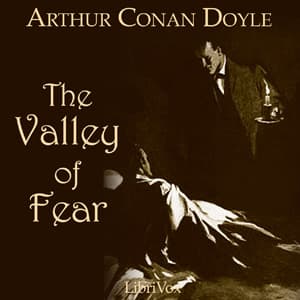

Okay, let's be real for a second. I listened to this while making a very complicated dal tadka—the kind my mother insists takes "patience and soul"—and honestly? The dal had more spice than this narration.
I love Sherlock Holmes. I really do. From a psychological perspective, Holmes is the ultimate case study in high-functioning sociopathy (or at least, extreme emotional detachment utilized as a defense mechanism). Doyle explores similar psychological territory—though with dinosaurs instead of detectives—in Lost World. But The Valley of Fear is special. It's Doyle's final full-length Holmes novel, and it's dark. We're talking secret societies, infiltration, and the kind of long-con revenge that requires a terrifying amount of cognitive focus.
But here's the problem.
The Case of the Missing Inflection
I usually advocate for audiobooks. I tell my students that hearing a story activates different neural pathways than reading. But Katie Riley's narration here? It's... a choice.
Look, she's clear. Her diction is crisp. If this were a manual on how to assemble Swedish furniture, I'd be thrilled. But this is a murder mystery involving a shotgun blast to the face and a transatlantic conspiracy. The delivery is just—flat. Monotone.
(My therapist would probably say I'm projecting my need for drama onto an innocent narrator, but I don't think so.)
There are moments where Holmes should be dripping with arrogance, or Watson should be sputtering with indignation, and instead, they both sound like they're reading a train schedule. Psychologically, it creates this weird dissonance. The text says "panic," but the voice says "afternoon tea." I found myself rewinding not because I missed a clue, but because my brain literally tuned out the frequency. It's the auditory equivalent of beige wallpaper.
I had to crank the speed up to 1.5x just to manufacture some urgency. Seriously, if you listen to this at 1.0x speed, you have more patience than I do.
The Architecture of Fear
That said—the story itself? Absolute gold. Once you get past the robotic delivery, the psychological underpinning of this book is fascinating.
Doyle does this thing where he splits the narrative. Part one is the investigation; part two is a flashback to the "Scowrers" (basically the Molly Maguires). As a behavioral psychologist, the second half is where I live. It's a perfect dissection of groupthink and the psychology of terror. How does a secret society maintain control? Fear. Coercion. The gradual erosion of individual identity until only the group remains.
The villain here isn't just a person; it's a system. And watching the protagonist infiltrate that system—wearing a mask of brutality to survive—is a stunning study in compartmentalization. I found myself asking: how long can you pretend to be a monster before the mask sticks to your face? The research actually shows that acting contrary to your values causes immense psychological stress, and Doyle—surprisingly—nails that tension. That same exploration of identity under pressure—though in a much more modern context—is what makes I Am Pilgrim so psychologically compelling.
Who's This For (And Who Should Run)
If you're a purist who just wants the text read aloud clearly while you fold laundry, this works. Holmes completists and Victorian crime enthusiasts will find plenty to chew on. But if you want to feel the fog of London or the terror of the Vermissa Valley—if you need your audiobooks to have a pulse—you're better off buying the paperback. Skip this version if flat narration makes you want to throw your headphones across the room.
My Prescription
The book itself is peak Victorian crime fiction. The plotting is tight, the twist is satisfying (even if you see it coming), and the look into organized crime is surprisingly gritty for Doyle. But the audio experience? It's a struggle. It lacks the theatricality that Holmes demands.
(Or maybe just find a version narrated by someone who sounds like they've actually witnessed a crime.)