
I was chopping onions for a curry that I knew was going to be way too spicy for anyone but me—standard Tuesday night behavior—when I decided to revisit the origin story of literature's most famous high-functioning sociopath. (Yes, I know the term is outdated, but let's call a spade a spade.)
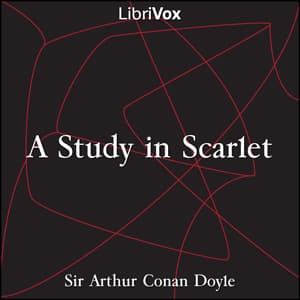
I've read A Study in Scarlet probably five times. My mother still asks why I buy new versions of stories I already know. "Maa, it's about the interpretation." And honestly? I wanted to see if this specific audio version could capture the exact moment Watson decided to become the world's greatest enabler.
Here's the thing about Sherlock Holmes: he requires a certain manic energy. A sharpness. He is a psychological mess held together by pure intellect. So, I pressed play on Bob Neufeld's narration, hoping for sparks.
The Voice of Detachment (Or Just Boredom?)
Let's be real for a second. Bob Neufeld has a voice like polished mahogany—deep, resonant, incredibly steady. If you want someone to read you the terms and conditions of a loan agreement, he's your guy.
But for a murder mystery? It was... a choice. I had a similar narrator mismatch with Total Control—great story, but the delivery didn't quite match the tension.
Psychologically speaking, Holmes is defined by his rapid-fire deductions and his utter lack of social grace. Neufeld's delivery is slow. Deliberate. He sounds less like a brilliant young detective and more like a tenured professor reading a syllabus he's taught for forty years.
I found myself zoning out during the crime scene analysis—which should be the best part! Some listeners found him monotonous, and frankly, I have to agree. There were moments where the distinction between Watson and Holmes blurred because the emotional affect was just so flat. My therapist would say the narrator was "emotionally withholding." I'd just say he made a thrill-kill feel like a lecture.
When Doyle Had a Dissociative Episode
If you've never read this book, there is a moment halfway through where the story just... breaks. We leave London. We leave Holmes. Suddenly, we are in the American West dealing with Mormons.
(I always forget this part happens. It's like the author had a dissociative episode mid-novel.)
Usually, I hate this section. It disrupts the pattern. But weirdly? Neufeld's gravitas actually worked better here. The second half is a grim, slow-burn tragedy rather than a snappy mystery, and his heavy, serious tone fit the landscape. It felt biblical.
But then we get back to London, and the accents... yikes. Look, I'm not a linguist, but some of the character voices felt like caricatures. It pulled me right out of the immersion. When you're analyzing character motivation, you need to believe the human (or character) exists. The inconsistent accents made that hard.
Who's This Actually For?
If you need a free or cheap version to get through a syllabus, this works fine. Students, completists, people who fall asleep to audiobooks (no judgment)—you'll be satisfied. But if you want to feel the psychological tension between two codependent men solving crimes in Victorian London? Keep looking.
Case Closed, Curry Cold
So, did I finish it? Yes. Mostly because I refuse to leave a case unsolved, even one I solved fifteen years ago.
Bob Neufeld gives a very classic, "old-timey radio" performance. It's competent. It's clear. But does it capture the neurotic brilliance of Holmes? Not really. It lacks the edge—that dopamine hit you get from a really sharp deduction. Affair: A Jack Reacher Novel delivers that same investigative rush, but with a narrator who actually understands pacing.