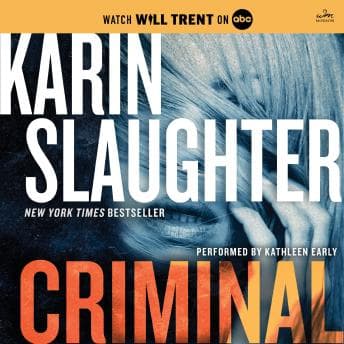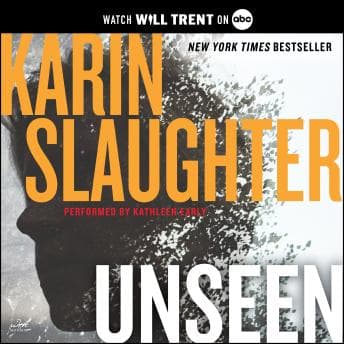
I was shelving the last cart of returns at the branch — it was maybe twenty minutes to close, that liminal time when the library gets genuinely eerie, fluorescents buzzing over empty reading tables — and I had Kathleen Early in my ears telling me about Will Trent bleeding into his cover identity as Bill Black. And I thought: this is a woman who understands that undercover narratives are horror stories wearing a thriller costume. Because what's scarier than losing yourself?
Karin Slaughter gets that. She's always gotten that.
The Slow Rot of a Good Man's Cover Story
Look, I need to talk about Will Trent for a second. Slaughter does something with this character that most thriller writers wouldn't dare — she makes his undercover work feel genuinely psychologically damaging, not cinematic. Will riding a motorcycle around Macon, projecting menace, befriending a wiry little drug dealer while being completely cut off from Sara? That's not a fun spy caper. That's dread. The kind of dread that sits in your stomach. Will's demons don't arrive with dramatic fanfare; they seep in through the cracks of his fake identity like water damage, and by the time you notice, the structure's already compromised.
And then there's Lena. God, Lena. Sara holds her responsible for Jared's shooting, and here's where Slaughter does something I genuinely respect — she doesn't let you off the hook by making one woman clearly right and the other clearly wrong. Sara's fury is justified. Lena's pattern of dragging people into her chaos is real. But Lena's also a cop trying to survive in a world that keeps shooting at her, and Slaughter refuses to flatten that into something comfortable. The allegiance-shifting in this book is not the cheap twist variety. It's the kind where you realize your sympathies have migrated without your permission.
This understands that horror isn't about gore — it's about dread. And yes, I know this is technically a thriller. But the way Slaughter writes violence — sudden, ugly, consequence-heavy — she's working in the same territory as the best horror writers. She just doesn't need the supernatural to get there. I kept thinking about how Thick as Thieves operates in similar territory — that same slow-burn dread built entirely out of human betrayal and consequence, no monsters required.
Kathleen Early's Southern Gothic Tightrope
The narrator commits. That's rare. Early's voice has this clean, controlled quality that works beautifully for the procedural sections, and she shifts into something rawer when Sara's anger surfaces. Her read on Sara confronting Lena — the barely-contained rage vibrating underneath professional composure — that's acting, not just reading aloud.
But I'll be honest: her Southern accent work is uneven. It's fine for most characters, natural enough that it grounds you in Macon, Georgia without feeling like a dialect showcase. But there are stretches — particularly with some of the rougher male characters — where the drawl leans a little heavy, a little performative. And her pacing runs hot. This is nearly thirteen hours, but Early reads like she's driving ten over the speed limit. For the tense sections, that urgency works. For the slower character beats, the ones where Slaughter is letting you sit with Will's deteriorating mental state? I wanted her to breathe. Let the silence do some work.
(My podcast listeners are going to love this debate, honestly. I can already see the Discord fight about whether fast pacing enhances or undermines tension in audio thrillers.)
At 1.0x, it's brisk. I wouldn't speed it up — you'll miss the plot mechanics, and Slaughter's plotting is a machine where every gear matters.
Who Gets the Most Out of This
If you've been following the Will Trent series, this is essential — the Sara/Lena collision has been building, and it pays off with real emotional weight. If you're new to Slaughter, this isn't the worst entry point, but you'll miss some of the accumulated history that makes Sara's fury land so hard. You'll understand what's happening; you just won't feel it in your bones the same way.
If you want a thriller that treats its characters like actual humans with complicated moral ledgers instead of chess pieces — yes. If you want something light and breezy for your beach vacation — absolutely not. Slaughter writes violence the way it actually feels: ugly, sudden, and leaving marks.
Shirley (my cat) was unimpressed. I was on the edge of my shelving stool.
The Lights Stay On for This One
Slaughter doesn't write horror, but she writes like someone who respects it. The "unseen" isn't a ghost or a monster — it's the compromises people make, the violence they absorb, the identities they put on that start fitting too well. Kathleen Early mostly serves this material well, with a few pacing hiccups that keep her from truly disappearing into it. But the story? The story earns its thirteen hours. It earns your attention. And it earns that sick feeling you get when the two investigations finally collide and you realize you saw it coming but couldn't stop watching anyway.
I listened in the dark. Mistake? Maybe. Worth it? Absolutely.