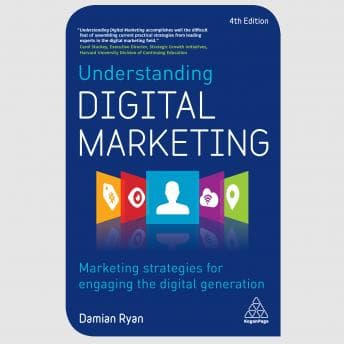

Everyone told me this was the digital marketing textbook. Harvard requires it. Over 100 universities apparently assign it. So when I saw it pop up on Audible, I figured - hey, 16 hours of what's basically a college course for the price of one credit? The ROI on this audiobook should be great, right?
I was half right.
The "Could've Been a Blog Post" Problem, But Make It 16 Hours
Let me be blunt: this book is a textbook that happens to have an audio version. And that distinction matters way more than you'd think. Damian Ryan clearly knows his stuff - the guy built the first digital agency in the UK and Ireland back in 1997, which in internet years makes him basically a founding father. The coverage is genuinely comprehensive: search marketing, social media strategy, affiliate marketing, email campaigns, mobile, performance marketing. It's structured like a survey course, each chapter tackling a different channel or concept, with case studies from brands like Kwik Fit, Battersea Dogs Home, and Yves Saint Laurent sprinkled in.
But here's where my 6AM Caltrain brain started rebelling. This is a fourth edition textbook, and it feels like one. Ryan walks you through concepts methodically, which is great if you're a marketing student prepping for an exam, but less great when you're trying to absorb it between dozing off and dodging someone's backpack. The information density is high but the narrative pull is low. There's no through-line, no story arc connecting chapter to chapter. It's modular - which works for a physical textbook you can flip through, but in audio format means you're basically listening to 16 hours of well-organized lecture notes.
I actually ended up listening to chunks of this during late-night debugging sessions last week instead of on my commute. Kevin had gone to bed, I was waiting for a deploy to finish, and the structured, methodical pace actually worked better when I could give it real attention. Weird how context changes everything.
James Langton Does His Job (And That's Literally All I Can Say)
Langton's narration is... competent. Clear, professional, well-paced. He reads a textbook like a textbook should be read. But there's not much room for a narrator to shine when the source material is explaining how Google Ads auction systems work or breaking down email open rate benchmarks. He's not doing character voices or building dramatic tension because there are no characters and no drama. It's a clean, informative read. I bumped it to 1.75x pretty quickly - my standard speed for business books that prioritize thoroughness over entertainment - and it held up fine at that pace without losing clarity.
No sound effects, no music, no production flourishes. Single narrator, straightforward delivery. It does what it needs to do.
Where the Actual Value Lives
Okay, so here's where I started discovering something as I sat with this more. If you strip away my audiobook-snob expectations and evaluate this purely as a reference resource, it's legitimately solid. Ryan doesn't just explain what each marketing channel is - he explains the strategic thinking behind choosing channels, measuring performance, and connecting tactics to business outcomes. The case studies aren't just "brand X did thing Y" - they walk through the reasoning and the results.
For someone transitioning into marketing from another field (hi, half my engineer friends who've gone into product management), this is basically a compressed MBA marketing elective. The affiliate marketing and performance marketing sections were genuinely useful for me - I've been curious about how those systems actually work from a business logic perspective, and Ryan explains the mechanics clearly enough that my systems-brain could map it.
But - and this is the big but - a lot of digital marketing moves fast enough that even a "fourth edition" starts showing age the moment it ships. Some frameworks and strategies will be evergreen. Specific platform tactics and case studies? Those have a shelf life.
Who Gets Value, Who Doesn't
Perfect for: Marketing students, career-switchers who want a structured foundation, anyone who needs to talk intelligently about digital marketing without actually being a marketer. Also genuinely good for focused listening during tasks that need partial attention - data migrations, waiting for CI pipelines, that sort of thing.
Skip for: Experienced digital marketers (you know this already), anyone expecting an engaging listen for commutes or workouts, and people who learn better from narrative-driven business books. If you want the engaging version, go read specific case study books instead.
And definitely skip if you're looking for a 6AM train book. I literally fell asleep during the email marketing chapter somewhere around Millbrae station and had to re-listen to 40 minutes.
The Honest Engineering Assessment
TL;DR: Worth your commute? No. Worth your focused attention during a slow deploy? Actually, yeah. This is a textbook that works as a textbook. The problem is that textbooks and audiobooks have fundamentally different UX requirements, and no amount of clear narration fixes that architecture mismatch. If you're going to listen, commit to focused sessions with the ability to pause and take notes. The information is genuinely good. The format just isn't optimized for the use case most of us buy audiobooks for. Bad Blood is basically the opposite problem - a story so narratively propulsive that I burned through it in three commutes and couldn't have told you I was learning anything until I realized I'd absorbed an entire education in startup fraud mechanics.