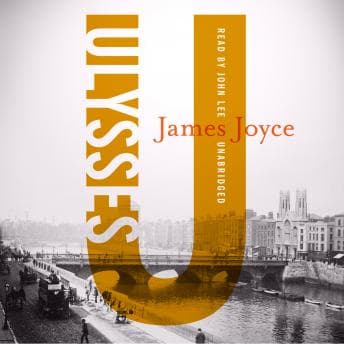

Everyone tells you Ulysses is the mountain you're supposed to climb. The literary Everest. The book English majors name-drop at parties but haven't actually finished. I've assigned excerpts to my AP students for years - the Proteus episode, Molly's monologue - and watched their faces cycle through confusion, horror, and the quiet resignation of people who just want to graduate. But here's the thing nobody prepared me for: listening to Ulysses is a fundamentally different experience than reading it. And I'm not sure I understood this novel until John Lee read it to me at 11 PM on a Tuesday while I pretended to grade essays on The Great Gatsby.
I say "pretended" because by the Lotus Eaters episode I had stopped grading entirely. Denise found me at midnight with my red pen uncapped and dry, headphones on, staring at the ceiling like a man receiving a religious vision. That same kind of absorbed, unexpected surrender happened to me with Fisherman — a book I picked up for a unit on narrative voice and ended up reading cover to cover in a single evening. She asked if I was okay. I was better than okay. I was finally hearing what Joyce actually wrote.
The Englishman Who Understood Dublin
Here's where I expected to disagree with the consensus. John Lee is English. Joyce's Dublin is so specifically, aggressively Irish that casting an English narrator feels like hiring a Bostonian to narrate Faulkner's Yoknapatawpha. But Lee does something sneaky - he doesn't perform Irishness, he inhabits it. His Bloom is weary and warm, slightly nasal, the voice of a man whose internal monologue runs like a river that keeps forking. His Stephen Dedalus is sharper, more clipped, intellectually vain in a way you can hear in the consonants. And Buck Mulligan - Lee gives him this booming theatrical energy that made me laugh out loud during the opening tower scene, which is not something I expected from a book I've taught for fifteen years.
The man voices hundreds of characters. Hundreds. Dublin barflies, priests, prostitutes, the ghost of Bloom's dead son. And you can tell them apart. Not because Lee does theatrical accent work like a one-man show, but because he understands that Joyce wrote each character with a distinct rhythm. Lee follows those rhythms like a musician follows a score. The narrator understands that pause is punctuation - and in Joyce, the punctuation is half the meaning.
Now. The complaints. Irish listeners have caught him mispronouncing place names - "Killiny" apparently gets mangled - and I'll take their word for it. As a Chicagoan, I know what it feels like when someone says "Chi-CAH-go" wrong, so I respect the irritation. But these are small stumbles in a thirty-hour marathon.
Molly Deserved Her Own Voice (And Lee Knows It)
Let's talk about what the author is really saying in that final monologue. Molly Bloom's unpunctuated stream of consciousness - "yes I said yes I will Yes" - is one of the most radical pieces of writing in English. It's feminine, sexual, defiant, drowsy, sacred. And John Lee reads it himself.
I understand why some listeners are disappointed. A woman's voice would have been a different kind of revelation. But here's what Lee does instead: he strips away the actorly performance. His Molly is quiet, almost murmured, like someone talking in half-sleep. He doesn't try to become a woman. He becomes the consciousness itself - that hypnotic, rolling, unpunctuated river of yes and no and memory. It's not the choice I would have made. But it's a defensible one, and Lee commits to it fully.
If you want the female Molly, Jim Norton's version with Marcella Riordan exists and it's worth comparing. But Lee's approach has its own strange beauty.
Why This Is the Version That Finally Made Me Finish
I'll confess something my students would never let me live down: I had never listened to Ulysses straight through. I'd read it in grad school - or "read" it the way grad students do, which means I read the chapters on the syllabus and faked the rest with secondary criticism. Twenty years of teaching and I was a fraud.
John Lee's narration made me honest. Because here's what audio does for Joyce that the page sometimes can't: it gives you the music. The Sirens episode, where Joyce structures the prose like a fugue - on the page, that's an intellectual exercise. In Lee's voice, at 1.0x speed (because the author chose those words and I choose to hear them properly), it becomes actual music. You hear the overlapping themes, the repetitions, the way "bronze by gold" functions as a motif. My students would hate this. I love it.
Thirty hours is a commitment. I won't pretend otherwise. There were stretches - the Oxen of the Sun episode, where Joyce parodies every style of English prose from Anglo-Saxon to modern slang - where I had to rewind and focus. This is not a background listen. This is not for your commute unless your commute is very long and you don't mind missing your stop.
Who Gets the Credit (And Who Walks Away)
If you've bounced off Ulysses on the page - and statistically, you have - this might be your way in. Lee's vocal clarity turns Joyce's stream-of-consciousness from impenetrable to merely challenging, which is a significant upgrade. If you're an Irish literature purist who'll notice every dropped vowel in a Dublin place name, you might prefer Norton's version. And if you want Molly Bloom voiced by a woman, same recommendation.
But if you want a single narrator who treats this impossible book like the performance art it deserves? Worth pausing the faculty meeting for. Worth thirty hours. Worth finally being honest about the greatest novel you never actually finished.
The Red Pen Stays Capped
This reminds me of what Hemingway said - that he'd learned from Joyce and couldn't have written as he did without him. Listening to Lee's Ulysses, I understand why. Joyce didn't just write a novel about one day in Dublin. He wrote the blueprint for how fiction could sound inside a human skull. And John Lee, an Englishman with no business being this good at it, made me hear that blueprint for the first time in twenty years of teaching it. The prose deserves to be savored. At 1.0x. With the red pen capped and the essays ungraded. Denise, I'm sorry about the Gatsby papers. They can wait.