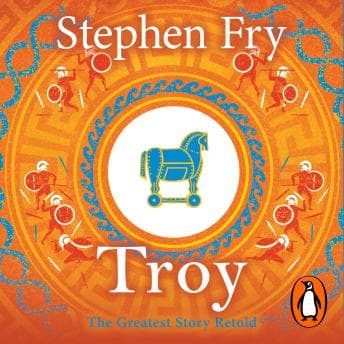

Stephen Fry is the DM we all wish we had.
I was supposed to be working on my thesis. Dr. Patel had sent another one of those emails—you know the type, the ones that start with "I'm concerned about your timeline" and end with you stress-eating ramen at 2 AM. So naturally, I opened Troy instead. Eleven hours later, my thesis remains untouched, but I can now explain the genealogy of every major Greek hero and exactly why Achilles was That Guy at the table who min-maxes his character but also has a tragic backstory.
Fry doesn't just retell the Iliad. He contextualizes it. He gives you the lore dump you didn't know you needed—who's related to whom, which god slept with which mortal, why Paris was basically the worst decision-maker in ancient history. If you don't like info-dumps, this isn't for you (but you're wrong). This is Sanderson-level world-building, except the world already exists and Fry is just reminding you how absolutely bonkers Greek mythology actually was.
The Voice of a Thousand NPCs
Here's the thing about Fry's narration: he doesn't do the Steven Pacey thing where every character sounds completely distinct. Pacey walked so other narrators could run, and Fry... Fry strolls. Leisurely. With a glass of wine. His approach is more subtle—inflection shifts, tonal changes, the occasional dry aside that makes you snort-laugh on the bus. When he describes Odysseus and Neoptolemus crouched inside the wooden horse, sweating in the dark, waiting for the signal? You can hear the tension in his pacing. The words slow down. You're in there with them.
His comedic timing? Impeccable. There's this moment where he's describing some particularly ridiculous divine intervention and you can practically hear the eyebrow raise. The man narrated Harry Potter. He knows how to make you feel like you're being told a story by your impossibly erudite uncle who's had exactly enough scotch to be entertaining.
Why This Hits Different for the D&D Crowd
My D&D group would devour this. Not because it's some action-packed combat fest—though the battle scenes deliver—but because Fry treats these myths with the same reverence we treat our campaign lore. Every character has motivation. Every god has an agenda. The ten-year stalemate makes sense when you understand the web of divine politics happening behind the scenes. It's like watching a campaign where the DM has been planning for years and every NPC has a three-page backstory.
The violence is there, and it's brutal—war-related brutality, the kind that reminds you the Iliad was never a sanitized tale. But Fry handles it with weight. When heroes fall, you feel it. When Achilles rages, you understand why the Greeks feared him as much as the Trojans did.
The Magic System Is... Well, There Isn't One (And That's Fine)
Greek mythology doesn't have a hard magic system. The gods do whatever they want, physics be damned. But Fry makes the internal logic work. Divine intervention feels consistent with each god's personality. Athena schemes. Aphrodite manipulates. Zeus tries to stay neutral and fails spectacularly. It's soft magic done right—you never feel cheated by a deus ex machina because Fry has already established that the gods are petty, vindictive, and absolutely will show up to mess with mortals for entertainment.
Who Should Siege This City (And Who Should Sail Home)
This is for you if: you love mythology, you appreciate a narrator who's genuinely enjoying himself, you want context for all those references in every fantasy book ever written. If you've read Mythos and Heroes, this is the payoff book. The trilogy conclusion. The siege you've been building toward. For a different kind of epic storytelling with equally high stakes, Timeless: A Drizzt Novel delivers that same sense of culmination.
Skip it if: you need distinct character voices to track dialogue, you want pure action without historical/mythological tangents, or you're looking for something to fall asleep to. This demands attention. Fry's wit rewards focus.
Roll for Initiative on That Credit
Eleven hours. Yes, it's worth it. I finished it in two days and immediately wanted to run a Greek mythology campaign. My thesis can wait. The Stormlight Archive can wait. (Okay, Stormlight can never wait, but you get the point.)
Fry takes stories that are literally thousands of years old and makes them feel urgent, funny, tragic, and deeply human. The wooden horse sequence alone—that absolute clinic in deception—had me holding my breath even though I knew exactly how it ended.
This is the audiobook equivalent of rolling a natural 20 on a history check and having your DM pull out the secret lore document they've been saving. Pure gold.