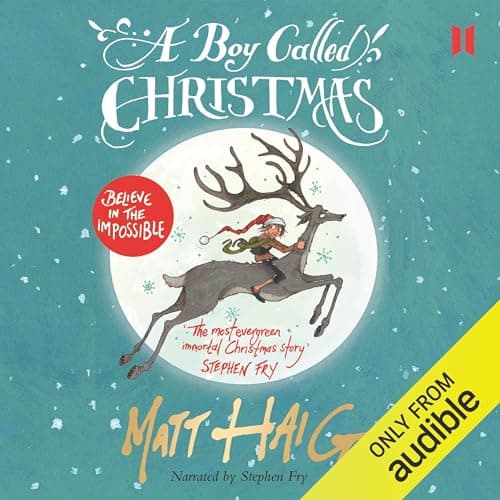

"If you believe that some things are impossible, you should stop considering listening right away." That's the warning Stephen Fry delivers in the opening minutes of A Boy Called Christmas, and honestly, it's the perfect litmus test for whether this audiobook is for you.
Bottom Line: Stephen Fry narrating a Matt Haig Christmas origin story at four and a half hours — basically a perfect gift-wrapping companion that'll make you laugh, then quietly wreck you. Works for kids and adults alike.
I put this on during a late December evening while wrapping gifts — four and a half hours seemed like exactly the right length to get through the pile — and what struck me immediately was how quickly I stopped paying attention to the tape and scissors. Matt Haig has written something that functions on two levels simultaneously: it's a genuine adventure story about an eleven-year-old Finnish boy named Nikolas trekking through frozen wilderness to find his father and the fabled village of Elfhelm, and it's also a wry, self-aware fairy tale that keeps winking at the reader without ever becoming cynical. That balance is tricky to pull off in prose. In audio, with the wrong narrator, it could fall completely flat.
Enter Stephen Fry, who was basically born to read this book. His voice carries exactly the right amount of authority — you believe him when he tells you something magical happened — and exactly the right amount of mischief. His delivery of the humorous asides, the narrator-breaking-the-fourth-wall moments, lands with a timing that I genuinely think surpasses what you'd get reading it silently. The mouse character Miika is a particular highlight. Fry gives him this slightly indignant, squeaky quality that turns what could be a standard animal sidekick into something genuinely funny. Every time Miika pipes up about cheese or complains about the cold, you can hear Fry enjoying himself, and that enjoyment is infectious.
The story itself follows Nikolas after his father Joel leaves on a quest to find proof that elves exist, hoping to claim a reward from the king that will lift the family out of poverty. When Joel doesn't return, Nikolas sets off with nothing but his father's hat, a turnip doll, and a stubborn refusal to accept that things are hopeless. Along the way he befriends a reindeer named Blitzen — and the scene where he pulls an arrow from the wounded animal is one of those moments where Fry's voice drops into something genuinely tender. It's a small scene, but it captures what makes this book work: kindness as an act of bravery.
The elves of Elfhelm, when Nikolas finally reaches them, are not the cheerful workshop assistants you might expect. Father Topo is warm and welcoming, but there's real tension in the community about whether humans can be trusted. Little Noosh becomes an ally, but the political dynamics of the elf village have real stakes. Haig doesn't condescend to his young audience. Bad things happen. People betray each other. The villain — Nikolas's aunt — is genuinely cruel in a way that younger listeners might find scary, though never gratuitously so.
At four and a half hours, this is a quick listen, and the pacing reflects that. The story moves briskly from one setpiece to the next: kidnapping, snowstorms, the discovery of Elfhelm, the conflict within the village, and the eventual resolution that plants the seeds for the Father Christmas mythology. No padding. Each chapter feels purposeful, and Fry reads them with a rhythm that knows when to speed up for action and when to slow down for the emotional beats. That kind of propulsive, chapter-to-chapter momentum is something I also noticed in Seventh Plague: A Sigma Force Novel, though the stakes there are decidedly less whimsical and more "global bioterrorism on my Tuesday morning train."
What makes this more than just a pleasant Christmas story is the undertone of sadness running through it. Nikolas has lost his mother. His father may be lost too. The magic in this world isn't free — it comes with costs and responsibilities. Haig treats grief seriously even while telling a story about talking mice and flying reindeer, and Fry's voice carries both registers without ever feeling jarring. One moment you're laughing at a deadpan aside, and the next your throat is tight.
As a family listen, this is close to ideal. My eight-year-old wandered in during the wrapping session and refused to leave until we'd finished. The story is accessible enough for kids who are old enough to follow a chapter book, but the writing has enough wit and emotional intelligence that adults won't zone out. It's the rare children's audiobook where the narrator elevates the material rather than simply delivers it.
If I have any reservation, it's that the brevity means some of the world-building in Elfhelm feels a bit rushed — you want to spend more time there, learn more about the elf culture, linger in the snow-covered streets. But that's what the sequels are for, and honestly, a story that leaves you wanting more is better than one that overstays.
Who Should Listen (And Who Should Skip)
Families looking for a holiday listen that won't bore the adults — this is your pick. Solo listeners who love a well-narrated fairy tale with actual emotional weight, same deal. Skip it if you need gritty realism or if whimsy makes you itch; this book runs on belief and kindness, and it's not apologizing for it.
Fry earned every bit of that AudioFile Earphones Award. This is a performance that makes you remember why audiobooks exist as their own art form — not as a substitute for reading, but as something that can do things a printed page simply cannot.