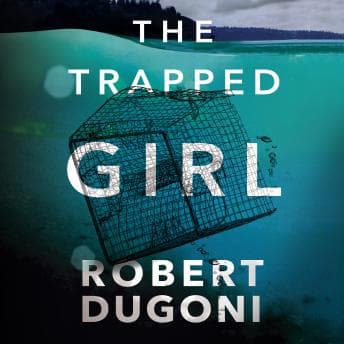

Everyone keeps telling me the Tracy Crosswhite series is "the next big thing in detective fiction," and honestly? I resisted for a while. Female detective with a dead sister haunting her past — I've seen that setup so many times I could write the character profile in my sleep. But here's the thing about The Trapped Girl: Dugoni doesn't just use Tracy's grief as window dressing. He actually understands how unresolved loss rewires a person's investigative instincts, making them simultaneously sharper and more reckless. That got my attention.
I was chopping onions for a chana masala at 9 PM on a Tuesday — the kind of elaborate meal I make when I'm procrastinating on revisions — and I nearly cut my finger when the opening scene dropped. A woman's body pulled from a crab pot in Puget Sound. Not just dead. Submerged. Deliberately placed. And here's where my brain immediately went clinical: the victim had gone to extraordinary lengths to conceal her own identity before she was killed. That's not a standard victim profile. That's someone operating under sustained psychological terror, someone who'd already internalized the belief that disappearing was safer than existing.
The Psychology of a Woman Who Erased Herself
What makes this book work — really work — is that the mystery isn't just "who killed her." It's "who was she." And those are fundamentally different questions that pull on different investigative muscles. The protagonist exhibits classic hypervigilance patterns tied to her sister's unsolved murder, and Dugoni lets that bleed into how Tracy approaches the Jane Doe case without being heavy-handed about it. Tracy doesn't monologue about her trauma. She just... pushes harder than she should. Stays later. Takes things personally when the evidence goes cold. The research actually shows that individuals with unresolved grief often develop what we call "proxy attachment" — they unconsciously transfer their emotional investment onto similar situations. Tracy does exactly this, and Dugoni writes it with enough restraint that it feels earned rather than manipulative.
The diary entries are where things get psychologically interesting. The victim's voice emerges through these chapters, and Sutton-Smith shifts into this soft, self-reproachful tone that immediately signals: this is a woman who blames herself for what's happening to her. Classic internalized victimization. I found myself asking: why does this woman narrate her own destruction with such quiet resignation? It's uncomfortable. It should be.
Sutton-Smith Knows the Difference Between Cold and Controlled
I've listened to plenty of thrillers where the narrator treats every scene like it's the climax. Breathless urgency from page one. Exhausting. I ran into that exact problem with Bad Place, where the relentless intensity actually flattened the emotional landscape. Sutton-Smith does the opposite. During investigation scenes — forensic details, evidence processing, the procedural grind — her tone goes crisply impersonal, almost clinical. Faintly ironic, even. Like a detective who's seen enough bodies that she can catalog details without falling apart, but not so many that she's stopped caring. Then she shifts — warmer, more emotional — when Tracy's with her team or sitting with her own thoughts. It's a small thing, but it creates this tonal architecture that mirrors how real investigators compartmentalize.
The childlike voices she gives certain characters are a bold choice. I wasn't sure about it at first — it felt almost too distinct — but it works because it creates instant psychological contrast. You hear vulnerability versus authority. You don't need it explained.
Pacing-wise, she never oversells the reveals. In a genre where narrators love to drop their voice to a dramatic whisper before a twist, Sutton-Smith just... delivers the line. Lets the writing do the work. My therapist would have thoughts about how refreshing it is when someone doesn't perform their emotions for an audience.
Where the Pattern Breaks (And Where It Doesn't)
Here's my honest issue: the resolution leans on "desperate greed" as a motive, and while the path to getting there is layered and satisfying, the final reveal didn't surprise me the way it wanted to. Psychologically, this doesn't fully track — or rather, it tracks in a way that felt too clean for a case this messy. The conflicting clues that muddy the investigation are genuinely well-constructed. The untangling is the best part. But once untangled, the answer felt... conventional. Like Dugoni spent 80% of his energy on a brilliant puzzle and then solved it with a motive I've encountered in a dozen other thrillers.
That said — and this matters — I was never bored. At 11 and a half hours, this is a commitment, but the alternating structure between present-day investigation and the victim's diary entries creates a rhythm that kept pulling me forward. It's the kind of book that demands your actual attention; I tried switching to background listening while grading and immediately lost the thread of a key forensic detail.
Who This Is For (And Who Should Keep Walking)
If you want a procedural that respects your intelligence and doesn't rely on cheap psychological shortcuts — yes. If you're already invested in the Tracy Crosswhite series, this is consistent with what Sutton-Smith has built across previous installments and arguably her strongest performance. If you need your thrillers to end with a gut-punch twist that reframes everything — temper your expectations. The journey here is better than the destination. And if you're someone like me who picks apart character motivations for a living, Tracy Crosswhite is one of the more psychologically coherent detective characters in the genre. She's not a genius. She's not broken-but-beautiful. She's just stubborn and grieving and good at her job. That's enough. Kay Scarpetta occupies a similar space in theory, though I found Autopsy leaned harder into the "genius forensic mind" archetype in ways that felt less psychologically grounded.
Case Study: Closed (Mostly)
This is a fascinating case study in how identity — the concealment of it, the search for it, the violence done in its name — can anchor a mystery more effectively than a body count. Dugoni understands human nature, even if his villains occasionally don't surprise me. The audiobook production is clean, Sutton-Smith is excellent, and I finished it standing in my kitchen at midnight with cold chana masala on the counter. Worth it.